Building a Collection #117: Richard Strauss' Eine Alpensinfonie (An Alpine Symphony)
With recommended recordings

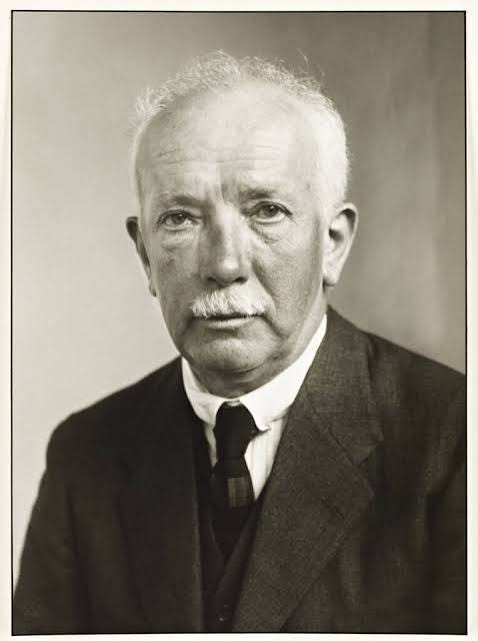
Building a Collection #117
Eine Alpensinfonie, Op. 64
By Richard Strauss
________________
“I want to be able to depict in music a glass of beer so accurately that every listener can tell whether it is a Pilsner or a Kulmbacher.”
-Richard Strauss
Welcome back! At #117 in our count “up” the list is the final tone poem composed by German composer Richard Strauss, Eine Alpensinfonie (An Alpine Symphony). Even though the word “symphony” appears in the title, the work bears more resemblance to a tone poem.
Richard Strauss (1864 - 1949)
Richard Georg Strauss was born in Munich in 1864, the son of the principal horn player in the Munich Court Orchestra. No relation to the Strauss family of Vienna waltz fame, Richard showed musical aptitude early on and took lessons in piano, violin, music theory, harmony, and orchestration. By the time Strauss reached adulthood, he was producing musical compositions of great maturity and sophistication. His father was one of his primary teachers, but he also learned under Ludwig Thuille, a family friend. Overall, his musical education was conservative in style. At the age of 17, he published his Serenade for 13 Winds, Op. 7, which led the conductor Hans von Bülow to declare Strauss “the most striking personality since Brahms.” Von Bülow would prove important in giving Strauss his first assistant conductor position. Through these early developments in his career, Strauss would grow to admire the writings of Schopenhauer and Nietzsche, and the music of Wagner and Liszt. Strauss would go on to have a very long composing and conducting career, which would take him all over Europe and to the United States.
The influence of Wagner in particular on Strauss’s style was to be significant, but at least initially his musically conservative father forbade him from studying it. The music of Richard Wagner was viewed with deep suspicion by the elder Strauss, and it was not until the age of 16 that Richard was able to obtain a score of Tristan und Isolde. In 1882 he went to the Bayreuth Festival to hear his father perform in the world premiere of Wagner’s Parsifal; there are surviving letters to his father detailing his seemingly negative impression of Wagner and his music. Later in life, Strauss would admit that he deeply regretted his conservative hostility to Wagner’s music.
Beginning with the “symphonic fantasy” Aus Italien in 1886, Strauss would begin a phase of his career where he would compose many of the most extraordinary tone poems in classical music history. It became evident that Strauss had a natural affinity and ability to write music for orchestra. Strauss brought the tone poem to its apogee with such works as Don Juan (1888-89), Ein Heldenleben (A Hero’s Life)(1897-98), and Also sprach Zarathustra (1895-96). Strauss possessed a supreme gift for using all the colorful possibilities of the orchestra to dramatic effect, as few ever have. Other well-known Strauss tone poems include Till Eulenspiegels lustige Streiche (Till Eulenspiegel’s Merry Pranks), Eine Alpensinfonie (An Alpine Symphony), Sinfonia Domestica, Don Quixote, Metamorphosen, and Tod und Verklarung (Death and Transfiguration).
Although Strauss grew up in a time when music was changing, with some composers such as Wagner and Bruckner looking ahead by using more groundbreaking styles, Strauss was more conservative. Strauss idolized Mozart and Brahms. Of Mozart, Strauss said, “The most perfect melodic shapes are found in Mozart; he has the lightness of touch which is the true objective.” Of course Strauss’ music does not sound like Mozart, but he certainly had a gift for melody not unlike Mozart. Strauss knew Brahms personally, and actually assisted in the preparation for the world premiere of Brahms’ Symphony no. 4 during his time at the Meiningen Court Orchestra. Strauss would later refer to this time as his “BrahmsschwärmereiIn” or “Brahms Adoration”. One of the reasons he revered Brahms was because Brahms himself was also a conservative composer in the sense of paying homage to past masters with rich, melodic themes and traditional structures.
In his use of logic and structure, Strauss had the goal of creating music that tells a story and has meaning. Strauss was one of the most “programmatic” composers in history, in other words he composed music that was written to describe extra-musical things. The music follows a narrative, and is meant to be descriptive or to evoke a scene or a mood through a theme or motif. This is one of the most defining features of Strauss’ music, as he himself said, “I want to be able to depict in music a glass of beer so accurately that every listener can tell whether it is a Pilsner or a Kulmbacher.” As such, the music of Strauss is very accessible, relatively easy to follow, and is decidedly tonal in nature. Strauss did not care to be avant-garde, at least not until the latter part of his career. Strauss did face critics that called his music “kitsch”, meaning music which is intended to evoke emotions, sentimentality and positive feelings, but which lacks authenticity and which is superficial and shallow. The accusation that Strauss’ music is kitschy is unfair and inaccurate in my opinion. In any case, if Strauss composed music full of meaning easily accessible to the common listener, what is wrong with that? Aaron Copland would follow a similar path, and that worked out well. Strauss’ development of the symphonic poem in itself was a significant departure from tradition, even though Tchaikovsky was doing something similar.
Around the turn of the century, Strauss became the director of Berlin’s Hofoper, and thus his interests turned more toward composing opera. After writing those many tone poems, for years Strauss had been gradually moving toward writing more opera. In the early years of the century, Strauss would compose some of his best loved operas including Salome (1903-05), Elektra (1906-08), and Der Rosenkavalier (1909-10). He would continue with several other critically acclaimed operas: Ariadne auf Naxos, Die Frau ohne Schatten, Die ägyptische Helena, and Arabella. From 1919 to 1924, Strauss was the principal conductor of the Vienna State Opera, and in 1920 he co-founded the Salzburg Festival with Max Reinhardt (incidentally the character of Uncle Max in Rodgers and Hammerstein’s The Sound of Music is based on Reinhardt) and set designer Alfred Rolle. The Salzburg Festival would go on to become one of the most renowned music festivals in the world, and is still going strong over one hundred years later. Strauss would compose more operas during war-time, which were somewhat more adventurous musically, and they were also well-received.
Strauss’ creative output dipped somewhat as he aged, but he then had an “Indian Summer” period from 1942 until his death in 1949 during which he composed several of his most moving and influential pieces including Metamorphosen, Oboe Concerto, Horn Concerto no. 2, and his heartbreaking Four Last Songs.
The latter part of Strauss’ career became embroiled with World War II and more particularly with the Nazi regime in Germany. Strauss’ relationship with Nazism is complicated. In 1933, Strauss was appointed to two positions within Nazi Germany, first as director of the Reichsmusikkammer (Reich Chamber of Music), which promoted “good German music” which was composed by Aryans and seen as consistent with Nazi ideals, while suppressing other, “degenerate” music, which included atonal music, jazz, and, especially, music by Jewish composers. The Chamber was founded in 1933 by Joseph Goebbels as part of the Reich Chamber of Culture, and it operated until the fall of the Nazi Germany in 1945. Strauss was also appointed principal conductor of the Bayreuth Festival, which was founded by Richard Wagner and mostly celebrated his music, after Arturo Toscanini resigned as a protest against the Nazi party. While Strauss has been criticized often for his apparent collaboration with the Nazis, his daughter-in-law was Jewish and it seems clear that much of his cooperation with the authorities was done to save her life and the lives of her children (Strauss’ Jewish grandchildren).
Strauss was essentially apolitical in his views, and he did not believe that art and politics should mingle. At the outbreak of World War I, Strauss was asked to sign a manifesto from German artists supporting the role of Germany in the war. Several colleagues signed it, but Strauss refused, noting in his diary “Declarations about war and politics are not fitting for an artist, who must give his attention to his creations and his works.”
The truth is Strauss never joined the Nazi party, and he carefully avoided situations where he would be forced to interact with Nazi officials. Strauss’ cooperation was motivated by his hope that Hitler would elevate German art and music, and because Strauss wanted to protect the reputation of composers such Mahler, Debussy, and Mendelssohn whose music had been banned. In 1933, Strauss wrote in his private notebook:
“I consider the Streicher–Goebbels Jew-baiting as a disgrace to German honour, as evidence of incompetence—the basest weapon of untalented, lazy mediocrity against a higher intelligence and greater talent.”
Because Strauss continued to rise in international prominence, the Nazis could not simply discard him. Ultimately, Strauss’ decision to remain apolitical as the head of the Reich Chamber of Music and Bayreuth was not tenable. Strauss is quoted as saying at the time,
“In November 1933, the minister Goebbels nominated me president of the Reichsmusikkammer without obtaining my prior agreement. I was not consulted. I accepted this honorary office because I hoped that I would be able to do some good and prevent worse misfortunes, if from now onwards German musical life were going to be, as it was said, “reorganized” by amateurs and ignorant place-seekers.”
Strauss privately scorned Goebbels and called him “a pipsqueak”.
In 1935, Strauss comic opera Die schweigsame Frau premiered in Dresden, an opera that he had worked with his Jewish friend and librettist Stefan Zweig. Because Strauss insisted on Zweig’s name being given equal billing for the opera, the opera was boycotted by the Nazi authorities and later banned after only a few performances. Strauss wrote a letter to Zweig saying,
“Do you believe I am ever, in any of my actions, guided by the thought that I am ‘German’? Do you suppose Mozart was consciously ‘Aryan’ when he composed? I recognise only two types of people: those who have talent and those who have none.”
The letter was intercepted by the Nazi authorities, and Strauss was dismissed from his post as head of the Reich Chamber of Music. Strauss thereafter used his considerable influence to prevent his daughter-in-law and grandchildren from being taken to a concentration camp. Sadly, Strauss could not save other members of his extended family, and some perished in the gas chambers.
In 1945, Strauss completed Metamorphosen, a piece written for 23 strings, in what is his most emotional and heart-wrenching work. Strauss poured out into the music his profound sorrow at the destruction of German artistic institutions including the bombing of every great opera house in Germany. At the end of the war, he wrote:
“The most terrible period of human history is at an end, the twelve year reign of bestiality, ignorance and anti-culture under the greatest criminals, during which Germany’s 2000 years of cultural evolution met its doom.”
Strauss is derided in some musical circles because he became quite formulaic in his symphonic poems and operas, and indeed some have the same characteristics. Some argue that Strauss did not grow as a composer as he aged, but rather recycled his old ideas, and just made them more sensationalistic and bombastic. I believe this is complete rubbish, reflecting snobbery and elitism. If you don’t like Strauss or any other composer, that is your preference. But the fact remains that Strauss’ music is still among the most often played music in the classical music world, and if it happens to lift your spirits and make you feel good, then that is a gift.
Eine Alpensinfonie
When Strauss completed Eine Alpensinfonie in 1915, it had been eleven years since his previous tone poem, Symphonia Domestica. At approximately 50 minutes length, and calling for an orchestra of no less than 125 musicians, it is one of Strauss’ longest and largest non-operatic works. It is a programmatic work, meaning that it depicts something specifically non-musical with the music. In this case, it depicts the 11-hour journey of climbing an Alpine mountain, from just before daybreak to nightfall. Some scholars and philosophers have also drawn other metaphorical meanings from the work, seeing it as a parallel to the human journey and spiritual striving. Strauss himself said of the work in his journal:
“The death of this aspiring, idealistic, energetic artist [is] a grave loss ... Mahler, the Jew, could achieve elevation in Christianity. As an old man the hero Wagner returned to it under the influence of Schopenhauer. It is clear to me that the German nation will achieve new creative energy only by liberating itself from Christianity...I shall call my alpine symphony: Der Antichrist, since it represents: moral purification through one’s own strength, liberation through work, worship of eternal, magnificent nature”
Strauss eventually gave up the Der Antichrist part of the title, and simply named it Eine Alpensinfonie. The score was finished in February 1915, and was dedicated “in profound gratitude” to Count Nicolaus Seebach, director of the Royal Opera in Dresden, where four of the six operas Strauss had written by that time had been premiered.
Strauss’ love of nature no doubt contributed to the work, and he loved the mountains so much he built a home in Garmisch-Partenkirchen, Bavaria complete with amazing views of the mountains. This perhaps also accounted for Strauss’ interest in the work of Friedrich Nietzsche, himself a nature lover. His work on the piece began as early as 1899, and eventually morphed into a work entitled Die Alpen (The Alps), which in turn became the core of Eine Alpensinfonie. However, it wasn’t until 1911 following the death of his friend Gustav Mahler that Strauss returned to the work in earnest.
Although the piece is played through continuously without a break like a tone poem, Strauss used titles to describe the different parts of the work in chronological order as follows:
Nacht (Night)
Sonnenaufgang (Sunrise)
Der Anstieg (The Ascent)
Eintritt in den Wald (Entry into the Forest)
Wanderung neben dem Bache (Wandering by the Brook)
Am Wasserfall (At the Waterfall)
Erscheinung (Apparition)
Auf blumigen Wiesen (On Flowering Meadows)
Auf der Alm (On the Alpine Pasture)
Durch Dickicht und Gestrüpp auf Irrwegen (Through Thickets and undergrowth on the Wrong Path)
Auf dem Gletscher (On the Glacier)
Gefahrvolle Augenblicke (Dangerous Moments)
Auf dem Gipfel (On the Summit)
Vision (Vision)
Nebel steigen auf (Mists Rise)
Die Sonne verdüstert sich allmählich (The Sun Gradually Becomes obscured)
Elegie (Elegy)
Stille vor dem Sturm (Calm Before the Storm)
Gewitter und Sturm, Abstieg (Thunderstorm and Tempest, Descent)
Sonnenuntergang (Sunset)
Ausklang (Quiet Settles / Epilogue)
Nacht (Night)
While some musicologists have tried to organize the piece into smaller chunks, that has been largely unsuccessful because it really defies any attempt to put it in a structure, other than the pictorial aspect and Strauss’ own descriptions.
I have borrowed the following guide to the piece from Marc Mandel, former Director of Program Publications for the Boston Symphony Orchestra:
“Strauss’s Alpine Symphony is in a single large movement some fifty minutes. The first two sections set the scene for the Alpine climbing expedition depicted in the course of the work. The summit of the mountain is reached midway through the journey, and, following the descent through a drenching downpour, the final sections serve as a coda to the whole. Strauss begins by depicting deep, mysterious Night with a dark, descending B-flat minor scale through which each added note is sustained so that all sound simultaneously. Trombones and bass tuba solemnly declaim the theme of the mountain, noble, imposing, majestic.
A softly undulating figure in low strings and bassoons leads to a tremendous buildup through the full orchestra (the opening of Wagner’s Rheingold cannot have been far from the Strauss’s mind) and night gives way to Sunrise. The theme of the sun is a glorious melodic outburst built, like the earlier depiction of night, on a descending scale, but now in the major mode and punctuated by cymbal crashes. The texture is enriched by a broad countertheme energized by motion in triplets. Another buildup, an accelerando, and a brief, dramatic pause now set us on our journey up the mountain with a quick marching theme, The Ascent, serving as a sort of “main theme” for the symphonic movement to follow. A pointed fanfare-like motif characterizes other aspects of the ascent to the peak, also serving to introduce the sound of a distant hunting party: six horns, two trumpets, and two trombones are heard from afar.
Our Entry into the Wood brings a broad additional theme for the brass, then a more relaxed version of the marching theme, heard against a background of string arpeggios, serving as a sort of relaxed second-theme unit in contrast to the faster version of the march. Birdcalls are heard and a solo string quartet initiates the passage leading to the next section of the score.
Now we have a large development section encompassing several phases of the climb: Wandering by the Brook, followed by cascading figures in the winds and strings for At the Waterfall. The Apparition section depicts, according to Strauss commentator Norman Del Mar, “the Fairy of the Alps appearing beneath the rainbow formed by the spray of the cascading water” and brings yet another broad theme for horns and violas, richly romantic, destined for a later important reappearance.
In On Flowery Meadows the march theme is heard softly in the cellos, the higher strings provide a soft backdrop, and isolated points of color (winds, harps, and pizzicato violas) dot the landscape. The pace quickens, and we have reached the expansive landscape On the Alm, the Alpine pastureland, where cowbells, bird song, sheep, and shepherds piping distract us from the climb that still remains.
A shrill cry from the woodwinds and yet another broad, airy theme begun by the horns propel us on our way. Now the going gets rough, and the shifting character of the music brings us Through Thicket and Undergrowth on the Wrong Path. A sudden sounding of the mountain theme on trumpets and trombones, and the climbers are On the Glacier, where the course of their progress through the Dangerous Moments that follow is charted by appearances of the original marching theme and the fanfare-like climbing theme. Suddenly we are On the Summit, the centerpiece of the score. The atmosphere is one of wonder and tense anticipation, as trombones proclaim a Zarathustra-like peak motif and then the solo oboe stammers a hesitant tune. There is a large buildup based on a succession of themes—the peak motif just introduced, the mountain theme from the beginning, and the broad horn tune from the “Apparition” passage—and a great climax for full orchestra, punctuated by the fanfare-like climbing theme, brings the recapitulation of the sun theme, gloriously proclaimed in C major.
This initiates another development-like section labelled Vision, based largely on the peak theme and the “Apparition” theme and characterized by shifting tonalities, with appearances of the sun theme and mountain theme preparing the way for a misty thinning of the orchestral texture as The Fog Rises. We hear soft fragments of the sun theme as The Sun Gradually Becomes Obscured. Mounting tension continues through the brief Elegy, and suddenly the Calm Before the Storm sets in: a rumble of timpani and bass drum, and the stammered woodwind tune heard earlier, perfectly capture the rarified pre-storm atmosphere.
There are isolated raindrops, ever-increasing gusts of wind, flashes of lightning, thunder, and suggestions of darkness (by allusion to the “Night” theme). Then the full fury of the storm is unleashed. Thunderstorm, Descent marks expedition’s last phase, and in it Strauss couples the climbers’ descent through the tempest with the recurrence of many of the ideas heard earlier—in reverse order and at a very quick pace as the mountaineers hurriedly retrace their steps: the marching theme (heard, appropriately for the descent, with its contours inverted), the fanfare, the waterfall music, the “Apparition” theme, and the woodland theme. When the storm subsides with a final gust of wind followed by isolated raindrops, the mountain’s noble theme is proclaimed once more by the brass, and the organ, which has been assuming increasing prominence, enters to introduce a ceremonial phrase in brass and harps. It is Sunset, and spacious treatment is given to developments of the sun theme.
Chorale phrases on solo organ, again taking the sun theme as point of departure, usher in the next-to-last section of the score, labeled Dying Away of Sound. In a passage parallel to the earlier “Vision” section, but in tones much softer, more relaxed, and marked “in gentle ecstasy,” winds and brass develop the yearning “Apparition” theme. Strings return to bring yet another development of the marching theme. The violins rise higher and higher until the E-flat tonality suddenly gives way to B-flat minor and the return of Night and a final statement of the mountain theme. A haunting, very slow variant of the marching theme ends with a final, dying glissando to the last note. We leave the mountain as we encounter it, shrouded in mystery and darkness.”
The Essential Recording
It has become ever more rare for me to recommend one recording as “essential”, but in this case I feel confident. There are many successful recordings of this work, and once it became more popular as the 20th century progressed, more and more outstanding recordings have appeared. Similar to Strauss’ Also Sprach Zarathustra, we cannot pretend that sonic considerations don’t matter with Eine Alpensinfonie, as they do matter a great deal in these colorful and large scale works. For me, a successful recording balances lyrical beauty, sonic impact, and forward propulsion. There are some recordings that emphasize the lyrical and structure more than power and pace, and that is a valid approach. However, for me, music by Strauss is meant to be larger than life and the performance should lean toward epic grandeur. Pacing should move along nicely without getting bogged down or racing through too fast.
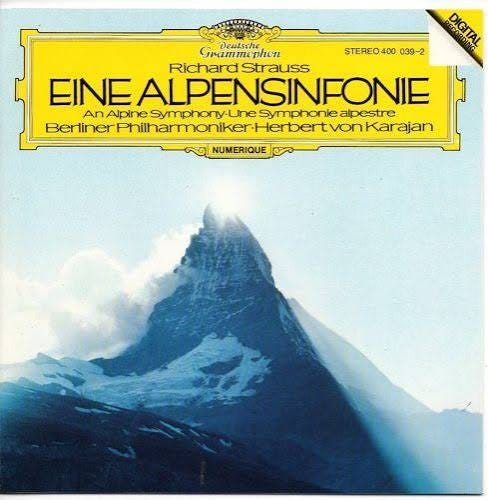
My essential recording of Eine Alpensinfonie is by the Berlin Philharmonic Orchestra conducted by Herbert von Karajan and recorded by Deutsche Grammophon in 1980 in the Philharmonie in Berlin. This recording by Karajan and the Berliners is stunning in its brilliance and sweep. This version has been a reference recording almost since the day it was released. While I find recordings from the latter part of Karajan’s career to be at times self-indulgent, overly glossy, and superficial, this recording of Eine Alpensinfonie, made in the early days of digital recordings, is one of the top 50 greatest classical recordings ever made in my opinion.
The first incarnation of this recording was almost unlistenable, as the digital overload and sheen made the strings extremely shrill, and the sound picture lacked enough depth. Happily, the recording has been remastered quite nicely, and now sounds very good. It still packs a punch in louder passages, and the dynamic range is wide.
Karajan was one of the foremost interpreters of Strauss’ music, and his vision here is to go big and to bring everything in this piece to the fore. The Berliners are simply breathtaking in their virtuosity, but it is virtuosity at the service of the music and of course Karajan. The strings and brass are stunning in their full tone, and the climaxes are spine-tingling. Sunrise, At the Summit, and the Thunderstorm are obvious places where you notice the full orchestra impact, but other quieter or more subtle passages are every bit as impressive. The musicians were clearly fully engaged, and they play as though this music is in their very bones.
Although Karajan was known to be controlling as a maestro, on this recording I find he is not overly controlling and actually gives the Berliners freedom to attack notes as they see fit. The ensemble between parts of the orchestra is not always perfect, but when they play with this kind of passion and commitment, a few blemishes can be forgiven. This is the BPO at their very finest, and indeed this is one of Karajan’s finest achievements. Strauss’ grand vision of humanity’s encounter with nature deserves a majestic reading that combines lyricism with a bold and broad sense of power and purpose, as this one does.
Recommended Recordings
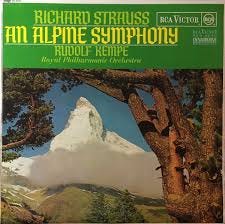
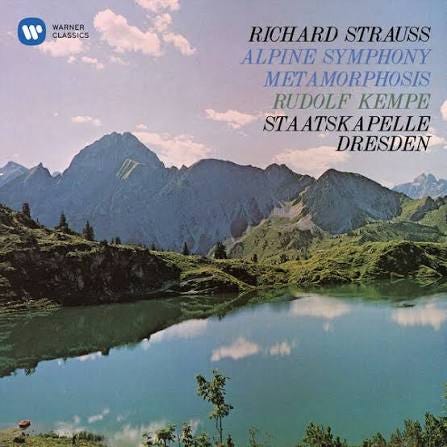
Rudolf Kempe was one of the most acclaimed Strauss interpreters of the twentieth century, and two of his recordings of Eine Alpensinfonie are recommended here. The first is his 1966 RCA recording with the Royal Philharmonic Orchestra (later appearing on the Testament label), and it has an urgency and bite that make it quite appealing. Recorded in Kingsway Hall, London, this recording has a spark, vitality, and edge to it, but still has a warm and full sound. Kempe balances the dramatic and lyrical masterfully here, and even if the reading is a bit more restrained than some other conductors, Kempe knows just how to convey the best in Strauss. His later 1971 recording on EMI (Warner) with the Staatskapelle Dresden, part of his highly acclaimed Dresden Strauss set, has many of the same refined qualities, but has even more lush and rich sound quality. I would say Kempe leads a bit more relaxed performance, but he also captures the joy and sheer beauty of each step in the journey. Again, sonic fireworks are not the goal, but Kempe gives the music a feeling and personality which transcend huge climaxes. Each step in the journey is well considered and guided with a sure hand. Many critics and listeners have made this recording their reference or standard recording, and it is easy to see why.
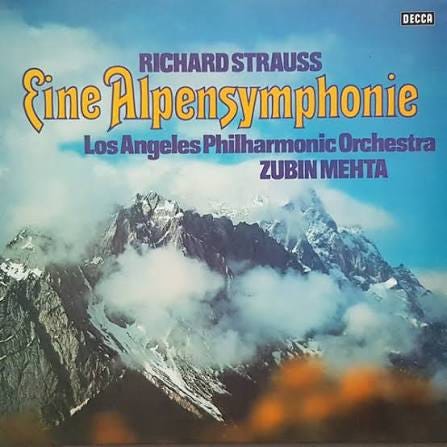
Zubin Mehta is sometimes underrated as a conductor, and especially in the earlier part of his career, he put down some excellent recordings. His 1975 Decca recording of Eine Alpensinfonie with the Los Angeles Philharmonic Orchestra is just one such example. The sonics are incredible, but typical of Decca’s rich analog recordings from the time period. Mehta’s approach is heavy on drama and creates a large sound picture, but it is an exciting performance which might not be as subtle or lyrical as some others, but there is still plenty of feeling and sense of variety in the pacing. The LAPO plays splendidly, and the recorded sound is immediate, rich, and resonant.
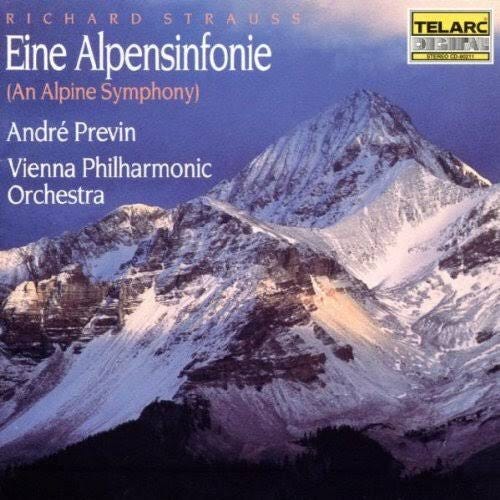
André Previn made a series of excellent Strauss recordings in the late 1980s with the Vienna Philharmonic Orchestra on the Telarc label, which at the time was known for its state of the art sound engineering. Previn is another conductor that I feel is undervalued a bit, and I do recall seeing him conduct in person a few times in Boston where he seemed a bit on autopilot. But here with the VPO he really rises to the occasion and seems to know exactly what he wants from this premier orchestra. Pacing is moderate, but just about right in my book. The opening segment has appropriate mystery and tension, and the first climax is clear and thrilling without going overboard. Sunrise and The Ascent are very well done, and On the Summit is wonderfully conveyed. Watch out for that extra bright tam-tam at the beginning of Entry into the Forest! The Thunderstorm is well judged also. In summary, this is still one of the best recordings available.
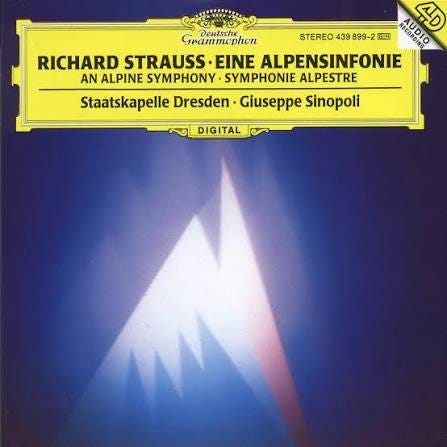
The Italian conductor Giuseppe Sinopoli was notoriously inconsistent on record, but he could be absolutely brilliant as he is here in his live 1993 recording of the symphony with the Staatskapelle Dresden on Deutsche Grammophon. The sonics are outstanding, and the reading is clean and clear in terms of phrasing and direction. Certain passages that spotlight specific instruments are played exceptionally well by the Dresdeners. Pacing is mainstream, neither too fast nor slow, but the pulse is maintained and nothing drags. The climaxes are simply stunning, and the more lyrical passages gain much from Sinopoli’s attention to the rhythmic nuances. There are a few very minor slip ups by the orchestra, but this is a reading of grandeur and authority. Sinopoli was always a superb Strauss conductor, and this recording is a great example.
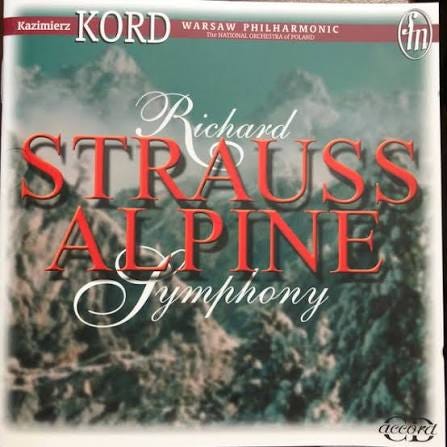
Once I heard a recording of Polish conductor Kazamierz Kord accompanying pianist Martha Argerich on a concerto along with the Warsaw Philharmonic Orchestra, and I recall being very impressed. In a similar way, turning to their live recording of Eine Alpensinfonie from 1998 on the Accord label also yields superb results. The acoustic is spacious and resonant, not too up close but also clear. The brass cut through quite well, and there is a real sense of theatre and purpose. Tempos are relatively mainstream, and each stop along the way is given its own personality and treatment. Kord is not afraid to alter tempos as the music and scene dictates, and that flexibility is really appreciated in this music. The brass have a sort of Russian-like tang to their sound too. The Entry into the Forest is shattering, and the lyrical passages following that are colorful and zesty. This is a most enjoyable trip up the mountain.
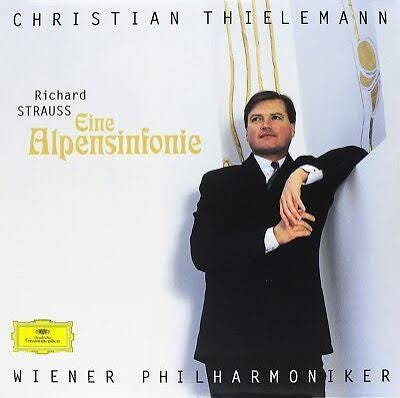
When Christian Thielemann’s live recording of Eine Alpensinfonie from the year 2000 with the Vienna Philharmonic Orchestra on Deutsche Grammophon has long been one of my favorite recordings of this work. For me, the work comes through fresh and majestic, with the VPO sounding marvelous. The sound is detailed, yet the acoustic has nice resonance and depth. The sound is true to what it is like to be in the actual music hall, but DG’s sound has good bloom and balance. This is essentially a performance which relies on the brilliance and lusciousness of the VPO, but for me that is exactly what I want with Strauss. Thielemann does not draw sharp lines or emphasize rhythms, but rather just lets the music luxuriate. Climaxes carry a lot of weight, as they should, and the lyrical passages are about as good as it gets on any recording. I’m not sure Thielemann has lived up to his potential since this recording was made, but I would not want to be without this one.
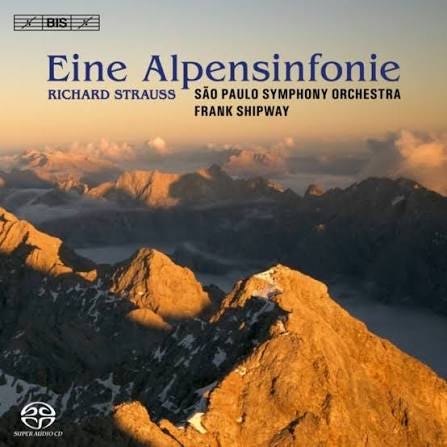
The 2012 recording by conductor Frank Shipway and the São Paulo Symphony Orchestra on the BIS label received rave reviews by the music press when it was released, and for good reason. This is as visceral an experience as you are likely to find on record for this symphony, and the clear, immediate, and resonant sound is demonstration class. Shipway didn’t make many recordings before his tragic death in an automobile accident in 2014, and he was known as a rather independent, iconoclastic figure. While the São Paulo orchestra might give you pause, there is no need because they sound as good as any orchestra on this list. There is a sense of forward movement, and urgency to their playing which gives the reading some electricity. Shipway controls the action well, but also allows the freedom for the orchestra to create a big sound in tuttis. There is much to recommend here, and this is easily one of the finest versions on the market.
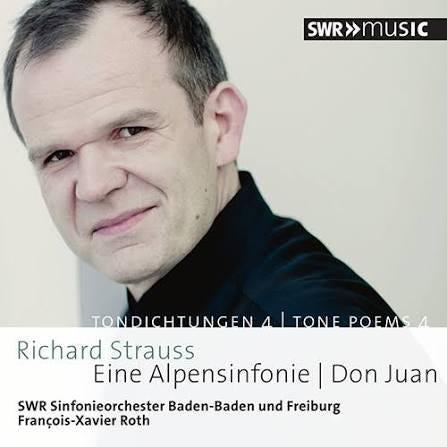
Another relative surprise for me is the 2014 recording by French conductor François-Xavier Roth leading the SWR Symphony Orchestra of Baden-Baden and Frieburg on the SWR label. Roth is mostly a period instrument specialist, so to find such a full-bodied and vibrant account from him was nice. Textures are marginally leaner and incisive, and Roth takes a structured approach to the score rather than a more leisurely or more lush and lyrical approach. But the recording is quite satisfying sonically, and the brass and woodwinds definitely lean to the more assertive side. The pacing is also on the quicker side, but not overly so, and for me keeping things moving actually pays dividends here. The climaxes are certainly big enough to capture the epic scale of the piece, and yet the softer passages also convey enough feeling. The orchestra, while not known as an internationally renowned group, performs very well and the sound is excellent.
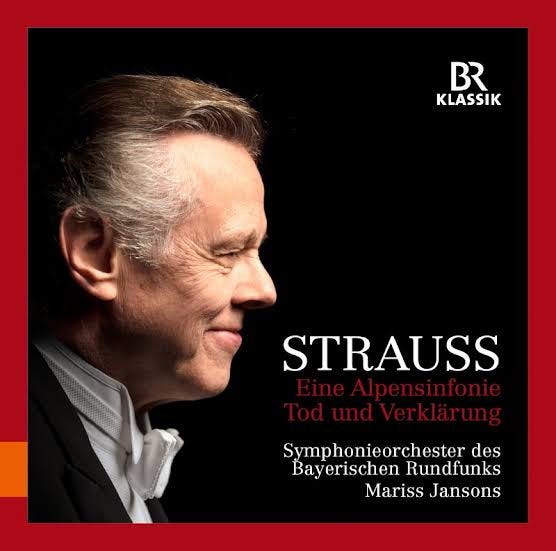
Mariss Jansons’ 2016 recording with the Bavarian Radio Symphony Orchestra on BR Klassik scores major points for the rich and sumptuous sound, as well as such detail that audiophiles will love. Jansons lets the music speak for itself, but I happen to like Jansons’ Strauss recordings. While as per usual, Jansons never strays far from the path, there are still plenty of interesting things going on here, and he balances power and sensitivity marvelously. This is a joyful and triumphant recording which follows in the footsteps of Kempe’s Dresden account in terms of lushness and rich sound. This live performance presents the piece in a coherent whole, and there is a real sense of an event here. I’ve thought that ever since I first heard it. Brass and percussion are just superb, almost flawless really. Next to Karajan, this one would certainly be in the very top tier of recordings.
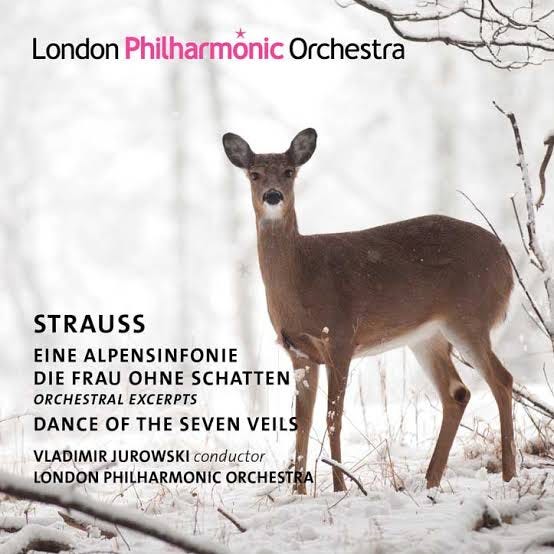
Also from 2016 is Vladimir Jurowski’s wonderful live performance with the London Philharmonic Orchestra on the LPO’s own label. The more objective, structured, and lean sound is a nice change to be honest, but there is still plenty of power and beauty. The opening Night and Sunrise sequence is dark, mysterious, and then thrilling. Pacing has nice flexibility to it, and while climaxes don’t carry the heaviness of some other recordings, the performance is none the worse for it. Acoustics from Royal Festival Hall are a bit on the dry side and the top end is balanced more heavily than the bottom. But it is clear that the LPO are really enjoying themselves here, there is lots of passion and drama to spare. Jurowski is really among the finest conductors when he gets results like this recording. He recorded the work again in 2019 with the RSO Berlin on Pentatone and that recording is also very fine (listed below), but this one has more snap and personality in my opinion.
Other Recordings of Eine Alpensinfonie You May Like
The truth of the matter is that the recordings below are all very good to great, and among them may be your favorites. There are so many quality recordings of Eine Alpensinfonie.
Bavarian State Orchestra / Strauss (Electrola 1941)
VPO / Knappertsbusch (Urania 1952)
Stuttgart / Schuricht (SWR 1955)
Dresden / Bohm (DG 1957)
Munich / Kempe (Munich 1971)
BRSO / Solti (Decca 1979)
Philadelphia / Previn (EMI/Warner 1983)
BPO / Ozawa (BPO 1985)
Concertgebouw / Haitink (Philips 1985)
Royal Scottish / Jarvi (Chandos 1987)
Euro Youth Orchestra / Judd (Alto/Regis 1987)
BPO / Mehta (Sony 1989)
SFSO / Blomstedt (Decca 1990)
VSO / de Burgos (Profil 1996)
BRSO / Maazel (BR 1998)
Zurich / Zinman (ArteNova 2001)
Weimar / Wit (Naxos 2006)
Concertgebouw / Jansons (RCO 2007)
Pittsburgh / Janowski (Pentatone 2009)
LSO / Haitink (LSO Live 2010)
BRSO / Welser-Most (BR 2010)
Waseda / Tanaka (Universal 2012)
Saito Kinen / Harding (Decca 2014)
Frankfurt Opera / Weigle (Oehms 2015)
CBSO / Nelsons (Orfeo 2016)
BSO / Nelsons (DG 2017)
RSO Berlin / Jurowski (Pentatone 2019)
Seattle / Dausgaard (Seattle 2019)
Oslo / Petrenko (LAWO 2020)
NHK / Jarvi (RCA 2025)
Thank you once again for reading. I hope you will join me next time for our review of Johann Sebastian Bach’s Sonatas and Partitas for Solo Violin at #118 on our list. See you then!
______________
Notes:
Boyden, Matthew (1999). Richard Strauss. Boston, Massachusetts: Northeastern University Press.
Brennan, Gerald. Reisig, Wayne Gerard. Schrott, Allen. Woodstra, Chris. All Music Guide to Classical Music, The Definitive Guide. All Media Guide. Pp. 1321, 1331. Backbeat Books, San Francisco. 2005.
Culshaw, John. Putting the Record Straight. Viking Press. 1982. Pg. 204.
Del Mar, Norman. Richard Strauss: A Critical Commentary on His Life and Works, Vol. 2. Ithaca, New York: Cornell University Press, 1969.
Gilliam, Bryan; Youmans, Charles (2001). “Richard Strauss”. Grove Music Online.
Kennedy, Michael (1999). Richard Strauss: Man, Musician, Enigma. Cambridge, England: Cambridge University Press. ISBN 978-0-521-02774-8.
Mandel, Marc. An Alpine Symphony. Found online at https://www.bso.org/works/an-alpine-symphony
Mandel, Marc. “Richard Strauss: An Alpine Symphony, Op. 64”[permanent dead link], Boston Symphony Orchestra; accessed 2 March 2009.
Moore, Ralph. Richard Strauss’s Eine Alpensinfonie: A partial survey of the discography by Ralph Moore. Found online at https://www.musicweb-international.com/classrev/2021/Nov/Strauss-Alpen-survey.htm
Reuth, Ralf Georg (1993). Goebbels. Harcourt Brace. ISBN 9780151360765. times when an artist of my rank has to ask a pipsqueak.
“Richard Strauss – Tone-Poem, Death and Transfiguration, Opus 24” Archived 2008-04-15 at the Wayback Machine (and other works), Old And Sold.
Richard Strauss & Romain Rolland (1968). Rollo Myers (ed.). Richard Strauss & Romain Rolland: Correspondence. Calder, London.
Richard Strauss, Eine Alpensinfonie and Symphonia Domestica, Dover 0-486-27725-9 (New York: Dover Publications, 1993).
Schmid, Mark Daneiel ed., The Richard Strauss Companion (Westport: Praeger Publishers, 2003), 112.
Youmans, “The Role of Nietzsche in Richard Strauss’ Artistic Development”, 339.
https://www.azquotes.com/author/20851-Richard_Strauss
https://en.wikipedia.org/wiki/An_Alpine_Symphony