Building a Collection #113: William Tell Overture
With recommended recordings

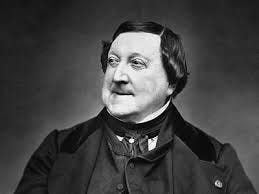
Building a Collection #113
William Tell Overture (Overture to the opera Guillaume Tell)
By Gioachino Rossini
________________
A warm welcome back to all subscribers, and hello to any new readers or subscribers out there. We have arrived at the second entry on our survey by the Italian composer Gioachino Rossini and probably his most well-known individual piece of music, the William Tell Overture in spot #113. A brilliantly famous, swashbuckling overture which is instantly familiar once the trumpet and horn fanfare begins about 8 minutes into the piece. I guarantee you’ve heard it.
Gioachino Rossini
Gioachino Rossini (1792 - 1868) was an only child from a musical family in Pesaro, Italy and by the age of 12 he was composing. He attended music school at the Liceo in Bologna, and his first opera was staged in Venice when he was just 18 years of age. Between the years of 1810-1823 Rossini wrote no less than 34 operas which were performed across Italy. Rossini composed some music other than operas, but today he is most well known for his opera buffo works, otherwise known as Italian comic opera.
During his period of great productivity, Rossini created his most well-known and popular comic operas including L’Italiana in Algeri (The Italian Girl in Algiers), Il barbiere di Siviglia (The Barber of Seville), and La Cenerentola (Cinderella). Rossini would also compose serious operas such as Tancredi, Semiramide, Otello, Le comte Ory, Le siege de Corinthe, Il viaggio a Reims, Mosè in Egitto, and his final opera Guillaume Tell (William Tell, from which comes the famous William Tell Overture, immortalized for being used as the theme for the Lone Ranger TV series in the 1950s). More on that below.
It has long been thought Rossini was greatly inspired when he heard the music of Mozart and Haydn. Indeed, his music has more in common with the classical era masters than the later Italian opera composers Puccini and Verdi. Rossini was a very quick learner, and was composing from a young age. After writing several operas while still in his teens, he was persuaded to move to Venice when he turned 18 to pursue opera composing full-time. At that time, Venice was known to be the center of the opera world.
Rossini became increasingly well-known through writing operas for performance in Rome, Milan, and Venice. The success he had with Tancredi (1813) made him internationally known as the opera was performed in London and New York. A few years later, Rossini moved to Naples and took up a post as director for the royal theatres. Naples had been an operatic capital previously, and native sons such as Domenico Cimarosa and Giovanni Paisiello were still celebrated for their operas. Rossini was seen as a bit of an outsider, but after the success of his operas Elisabetta, regina d’Inghilterra and L’italiana in Algeri he was fully accepted by the Neapolitan public. While most of his operas were composed for production in Naples, importantly in 1816 he wrote Il barbiere di Siviglia (The Barber of Seville) for Teatro Argentina in Rome. Il barbiere di Siviglia would become Rossini’s most enduringly popular opera.
It is noteworthy that Rossini often recycled his own music for “new” productions, and would sometimes adapt melodies and tunes to fit different lyrics. You may notice that some of the music for the incredibly difficult tenor aria Cessa di piu resistere (in Act II of The Barber of Seville) was later also used by Rossini for the mezzo aria Nacqui all’affanno…non piu mesta (in Act II of La Cenerentola). Portions of specific overtures were also reused in other works. This was not so uncommon in Rossini’s time.
In the early 1820s Rossini became disillusioned with Naples, and moved to Vienna where he was welcomed like a conquering hero. Several of his operas were quickly produced in Vienna to rapturous reception. During this time Rossini was able to meet Beethoven, and Beethoven expressed admiration for Rossini’s work, and in particular the comic operas. Although Rossini would spend time in London, the reception he received was chillier, and from 1824 he retreated to Paris where he felt much more at home. It was in Paris where Rossini began to gain weight to the point where he cut quite a rotund figure. He composed some operas after being commissioned by the French government, eventually writing four operas in the French language (with Le comte Ory being the lone comic opera in French). What would turn out to be his final opera, Guillaume Tell, was staged in 1832 and was very well received. Rossini’s reputation became even greater and he was revered in both France and Italy. While not producing any more operas, Rossini composed his Stabat Mater (1841) and his Petite messe solennelle (1863).
One of the most extraordinary facts about Rossini is his retirement from composing when he was only in his 30s, and that he didn’t write any operas for the last 40 years of his life. It is somewhat of a mystery why Rossini stopped composing after being so prolific and having such great success. Some scholars theorize it may have been due to poor health, or achieving fame and wealth to a level he didn’t need to work, or perhaps the field of opera was undergoing some major shifts at that time. We know Rossini suffered from gonorrhoea as well as depression after the death of his mother, some even claiming he had bipolar disorder. In any case, his withdrawal from composing prompted the critic Francis Toye to comment in his 1934 study of Rossini: “Is there any other artist who thus deliberately, in the very prime of life, renounced that form of artistic production which had made him famous throughout the civilized world?”
Rossini’s legacy has been somewhat diminished by the changes in the music world, and particularly opera, over the years. At some point Rossini’s operas were criticized as being unserious and too repetitive. However, composers such as Verdi, Respighi, Offenbach, Adam, Auber, and Britten all drew inspiration from Rossini, and in the 20th century there developed a renewed appreciation for his body of work.
William Tell Overture
The William Tell Overture is the overture to the opera William Tell, or in the original French Guillaume Tell. The opera premiered in 1829, and was to be his last opera. Rossini would continue to compose sacred works and cantatas, but no more operas.
Although the overture is separated into four uninterrupted themes, it is the final theme which has made the overture so famous. It became the theme for the 1950s American TV show The Lone Ranger, and has come to represent horseback riding since then. It was also used for the British TV series The Adventures of William Tell. Franz Liszt also made a piano transcription of the overture in 1838, which became rather popular on its own.
A typical performance of the complete overture runs for about 12 minutes, and the setting it depicts is the Swiss alps where the opera takes place. Rossini himself divided the work into four parts, though they flow seamlessly from one to the next without a break:
Prelude: Dawn
Storm
Ranz des vaches (Call to the Cows)
Finale: March of the Swiss Soldiers
Each part has its own personality, and in that sense it is almost like a mini-symphony. But things really get going in the finale, certainly the most familiar part of the overture. While horses or cavalry play no role in actual opera, this music has become associated with galloping horses, or a hero on horseback riding to the rescue. Indeed, it is difficult for me to even hear this music without thinking of The Lone Ranger, and it aired well before I was born! Composers such as Johann Strauss I and Dmitri Shostakovich borrowed quotes from this music for their own works.
The work also features in Walt Disney’s Mickey Mouse cartoon The Band Concert, and it was used as a parody in Bugs Bunny’s Overtures to Disaster and Bugs Bunny Rides Again. Daffy Duck also sang the tune to special lyrics in Yankee Doodle Daffy.
But where the majority of people have heard the overture is likely in TV advertisements, where the finale has featured repeatedly particularly in ads for products targeting male consumers.
The overture is also heard in Stanley Kubrick’s film A Clockwork Orange, as well as in The Princess Diaries, as well as its sequel. The actor, pianist, and comedian Victor Borge would use the piece as part of his act, playing it “upside down” then “right side up”. College and professional sports teams have often used the overture as a rallying cry, and the list goes on for all the various contexts in which you might hear this music.
One of the things that has struck me in going back and listening to many recordings of the piece again is just how challenging it sounds in terms of getting it right. You have the most delicate and gentle sections which require enormous grace and lyrical sense, and then you have both the storm and the finale, which are barn-burners. I’m not “in the know” as to whether it is actually a difficult piece to play, but some of the rhythmic qualities, particularly in the finale, seem challenging to pull off successfully. This is especially true on a recording, where there has to be maximum control and detail. See below for some recordings that get it right.
Recommended Recordings
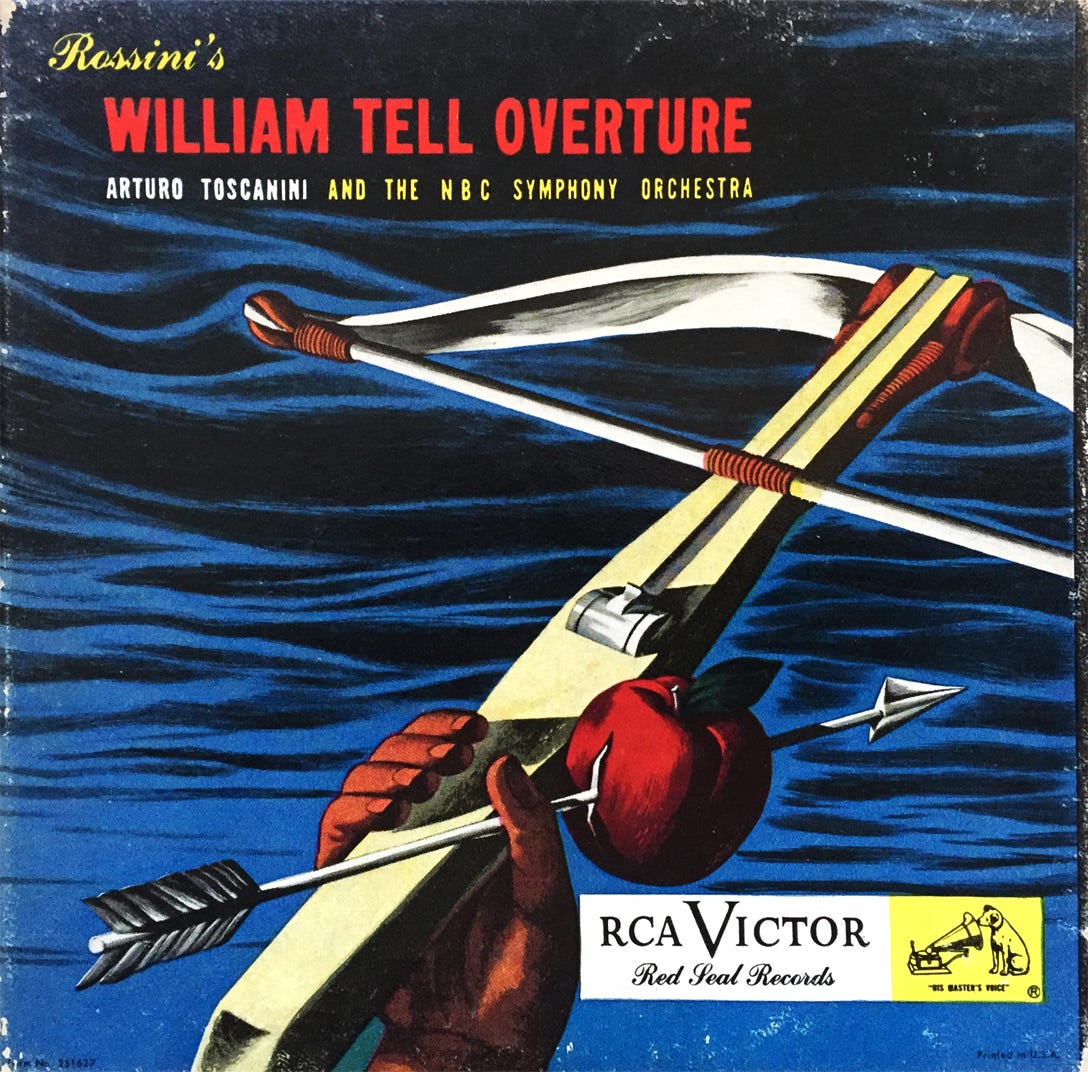
The oldest recording I’m recommending is from 1953 with Arturo Toscanini leading the NBC Symphony Orchestra on RCA. I owned this on an old “Toscanini Collection” CD, and I always felt it was ideal for Toscanini. There is discipline and control, but also adrenaline and propulsion. The somewhat boxy sound has been improved in recent incarnations, and Toscanini had a brilliant touch with Italian opera repertoire. He also recorded it back in 1939, but this later one is preferable.
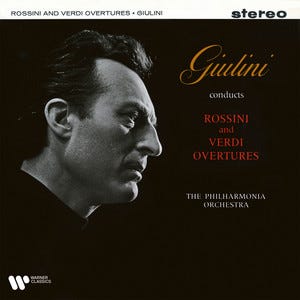
Next up is Carlo Maria Giulini’s outstanding recording of the overture from 1955, where he leads the Philharmonia Orchestra on EMI (Warner). Again, I have owned this set for more than 30 years, and all the overtures sound just about right to me here. The Philharmonia sounds superb, rich and sonorous. Giulini was an absolute star of the mid to late 1950s, and his direction here fully explores the lyrical side, but especially the more dramatic sections. The calling of the cows section has perhaps never been played better, and when the brass enter it virtually takes your breath away. I’m also a fan of how Giulini emphasizes the brass punches in between the strings in the finale; they come through marvelously, bringing great rhythmic life to the performance. Strongly recommended.
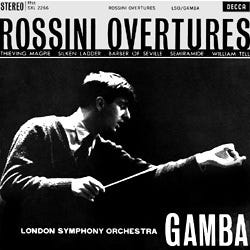
From 1960 we have the legendary recording by Piero Gamba and the London Symphony Orchestra on Decca, and in classic Decca sound. This may be my favorite of them all, it is just so thoroughly warm and electrifying at the same time. Gamba spent most of his career leading orchestras in Spain and South America, and thus he doesn’t have the name recognition of some others. But make no mistake, this as committed and as passionate as you will ever hear the William Tell. Dynamics are so well done too, especially in the finale where Gamba keeps his foot on the accelerator, strings swell nicely and brass bray with bite. The strings of the LSO are especially impressive. As good as it gets in my book. Recommended.
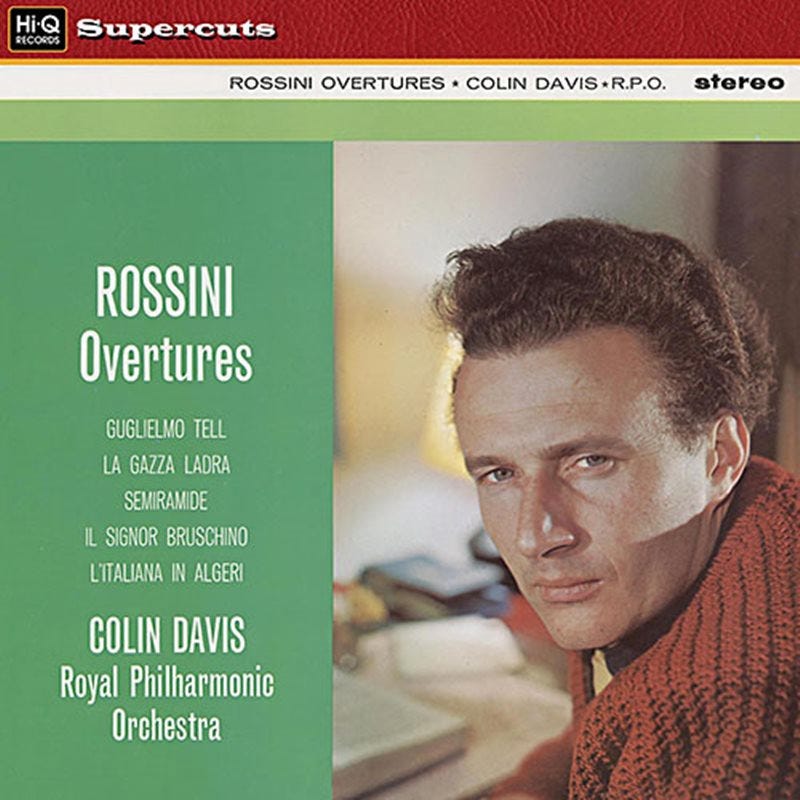
I wasn’t aware of Colin Davis’ set of the Rossini overtures for quite a while, and when I heard them paired with Davis’ recording of Beethoven’s Seventh with the Royal Philharmonic Orchestra from 1961 on EMI (Warner), I was immediately impressed. I guess it makes sense really, as Davis was a great opera conductor, and had an affinity with Mozart and Beethoven, which certainly influenced Rossini. This is a gorgeous recording, showing the RPO fully the equal of the LSO of the time (with Gamba above). The sound is from Abbey Road, and is really quite good, well balanced and warm. The storm section could be a bit more menacing, but the finale is fully satisfying, dramatic and thrilling.
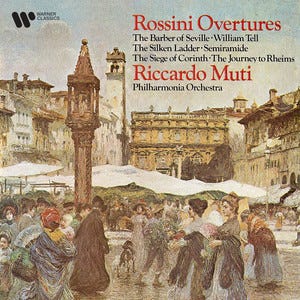
I also wasn’t aware of Riccardo Muti’s set of the Rossini overtures until recently, and they were a pleasant find. His recording comes from 1978 with the Philharmonia Orchestra on EMI (Warner). This is red-blooded Rossini, with Muti still in the more spontaneous portion of his career, and with warm and balanced sound from Kingsway Hall in London. Muti covers all the bases, but more than that he adds muscle to the brass in the storm, and the finale takes off with the momentum and bite I like to hear. Similar to Gamba, he doesn’t take his foot off the accelerator in the least in the finale. This is rough and ready Rossini, and absolutely thrilling.
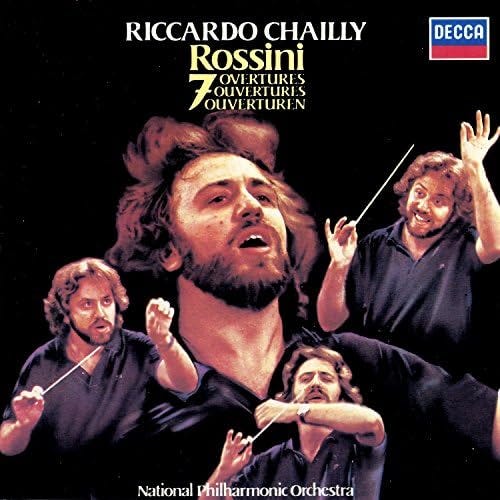
Italian maestro Riccardo Chailly has recorded the overture twice, but it is his first recording from 1981 on Decca with the National Philharmonic Orchestra (London) which is the recommendation. Chailly’s entire set of the overtures here is quite good, and again we have the trademark warm Decca sound. Chailly directs a clear sighted, dramatic, and weighty performance which satisfies on all counts. The storm lumbers a bit, but the calling of the cows and the finale rev things up a lot, and the conclusion packs plenty of punch.
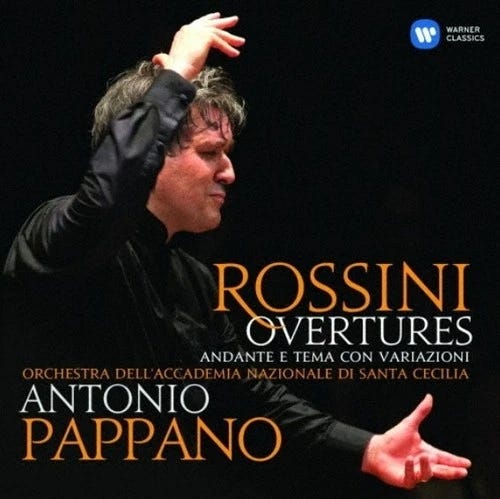
Finally there is Sir Antonio Pappano’s 2011 recording with the Orchestra dell’Accademia Nazionale di Santa Cecilia on EMI/Warner, again with Pappano’s opera credentials preceding him. The storm is somewhat tame, but the intro and the calling to the cows, and finale all hit the right mark. Nice dynamic shading is paired with the ability to hear all the voices throughout the orchestra, which I like a lot especially in the faster, denser passages near the end. I would like to hear the strings come to the fore a bit more, but that’s nit-picking.
Other William Tell Overture Recording You May Like
NBC / Toscanini (RCA 1939)
Santa Cecilia / De Sabata (Naxos 1948)
Columbia / Rodzinski (Columbia 1950)
Chicago / Reiner (RCA 1958)
Detroit / Paray (Mercury / Decca 1959)
Philharmonia / Karajan (EMI/Warner 1960)
New York / Bernstein (Sony 1965)
Royal Philharmonic / Gardelli (EMI/Warner 1972)
Bamberg / Patane (Sony 1989)
Chamber Orchestra of Europe / Abbado (DG 1991)
Philadelphia / Milanov (Philadelphia 2005)
Budapest / A. Fischer (Hungaroton 2014)
Thank you once again for joining me on this journey! I hope you find some recordings of this fun overture that you love. Join me next time when we discuss Mozart’s enchanting Clarinet Concerto number #114 on our list. See you then!
_________________
Notes:
Friedwald, Will and Beck, Jerry (1981). The Warner Brothers Cartoons, p. 101. Scarecrow Press
Goldmark, Daniel (2005). Tunes for ‘toons: music and the Hollywood cartoon. University of California Press, p. 39. ISBN 0-520-23617-3
Gossett, Philip (2001). “Rossini, Gioachino (Antonio)”. Grove Music Online. Oxford University Press. doi:10.1093/gmo/9781561592630.article.23901.
Gossett, Philip; Brauner, Patricia (1997). “Rossini”. In Holden, Amanda (ed.). The Penguin Opera Guide. London: Penguin. ISBN 978-0-14-051385-1.
Hamilton, Kenneth (2005). The Cambridge Companion to Liszt. Cambridge University Press, p. 82. ISBN 0-521-62204-2
Kendall, Alan (1992). Gioacchino Rossini: The Reluctant Hero. London: Victor Gollancz. ISBN 978-0-575-05178-2.
Kinscella, Hazel Gertrude (1941/2005). Music and Romance. Kessinger Publishing, pp. 389–390. ISBN 1-4179-9594-7.
Meyers-Levy, Joan (1993). “Gender Differences in Cortical Organization: Social and Biochemical Antecedents and Advertising Consequences” in Attention, Attitude, and Affect in Response to Advertising (edited by E. Clark, T. Brock, and D. Stewart). Routledge, p. 117. ISBN 0-8058-0756-X
Osborne, Richard (2007). Rossini (second ed.). Oxford: Oxford University Press. ISBN 978-0-19-518129-6.
Rasmussen, Randy (2005). Stanley Kubrick: Seven Films Analyzed, p. 157. McFarland
Servadio, Gaia (2003). Rossini. London: Constable. ISBN 978-1-84119-478-3.
Studwell, William Emmett (1997). The Americana Song Reader. Routledge, pp. 90–91. ISBN 0-7890-0150-0.
The Best of Victor Borge, Act One and Two
Toye, Francis (1947) [1934]. Rossini: A Study in Tragi-Comedy. New York: Knopf. OCLC 474108196.
Weinstock, Herbert (1968). Rossini: A Biography. New York: Knopf. OCLC 192614.
For my money Abbado and the COE deserves a first recommendation.
You shoud listen to Roger Norrington with London Classical Players on EMI too.