Building a Collection #110: Stravinsky's The Firebird
With recommended recordings

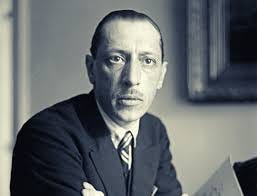
Building a Collection #110
L’Oiseau de feu (The Firebird)
By Igor Stravinsky
________________
“There is no beauty in Music itself, the beauty is within the listener”
-Igor Stravinsky
Welcome to Building a Collection, where we discuss the greatest 250 classical music works of all-time. At #110 is Stravinsky’s ballet The Firebird. A smash hit from the time of its premiere, The Firebird is one of several ballets Stravinsky wrote in the early 1900s for the Ballets Russes ballet company in Paris, and it really cemented him as one of the greatest composers of the 20th Century.
Igor Stravinsky
Igor Stravinsky was born in 1882 in Orianenbaum, Russia (near St. Petersburg) and died in 1971 in New York. Highly original and inventive, he is one of the most influential composers in history. Stravinsky’s style is hard to pinpoint, as he moved from styles as diverse as Russian nationalism to neo-classicism to 12-tone principles to jazz-inflection. Even with these diverse guises, his music always retained its own identity.
When he was young, Stravinsky was not a musical prodigy. Although he entered law school in the early 1900s, Stravinsky loved music and began private composition and orchestration studies with the famous Russian composer Rimsky-Korsakov. Soon he was producing his own compositions, and he caught the attention of ballet impresario and founder of Ballets Russes Sergei Diaghilev. Diaghilev subsequently asked Stravinsky to compose ballet music for his company. A triad of early ballets, The Firebird (1910), which made him famous almost overnight, Petrushka (1911), and The Rite of Spring (1913) cemented Stravinsky’s reputation as one of the most important composers of his time.
In those early works, although they were typically nationalistic, it was already evident that Stravinsky was a risk-taking and unusual composer. While his writing was for the ballet, the music stood on its own and went far beyond what was required for the dance. Stravinsky’s use of “polytonality” was unique and striking for the time. Polytonality is the use of more than one key in the music simultaneously. It adds complexity, color, and often dissonance to the music, and Stravinsky was a master at using it. To ears accustomed to hearing classical and romantic themes up until the twentieth century, Stravinsky’s music would have sounded completely different, modern, dissonant, sharply-angled, even ugly. Stravinsky was also quite original with his use of rhythms, and his use of different rhythmic combinations became another hallmark of his musical style.
Stravinsky would live in France in the 1920s, and his works from that period were influenced by the jazz music that was taking hold in Paris. His works Ragtime and The Soldier’s Tale are examples of this, but then he soon turned to a more neoclassical style with such works as Pulcinella, Symphony of Psalms, and The Rake’s Progress. These compositions would have a lot of impact, and would also influence other composers, especially in America. Stravinsky toured America in the 1930s, and wrote several other pieces commissioned by American orchestras.
Sadly Stravinsky’s wife, daughter, and mother all died within the space of a year and in 1940 he emigrated to America, settling in California. Stravinsky was eventually influenced by the more modern 12-tone movement, and he composed several works using 12-tone as a tool, but always in his own original way. In the late 1950s and early 1960s when stereo recordings were beginning, Stravinsky made a series of recordings where he conducted his own works for Columbia Records (now on Sony). He continued composing until his death in 1971. Stravinsky’s legacy on the classical music world cannot be overstated, especially his influence on 20th century and modern classical music. He significantly influenced many, many composers throughout his life and since, and deserves to be in the pantheon of the great composers.
L’Oiseau de feu (The Firebird)
I will refer to this work as The Firebird from here on, although the French was used originally due to its French origin and premiere in Paris. Also, in this post I will be referring to the complete ballet music for The Firebird using the 1910 score, and NOT any of the versions of the Suite, which are often used in concert. That is not to belittle the Suite at all, but I’m a bit of a completist in my outlook.
Rather famously, the Russian impresario Sergei Diaghilev founded the Ballets Russes ballet company in Paris in 1909. Diaghilev had already been impressed by some of the music he had heard from Stravinsky, and so he approached him to commission him to orchestrate the music from Chopin for the ballet Les Sylphides, and Stravinsky had completed this by March 1909.
Diaghilev was working with the famous ballet dancer and choreographer Michel Fokine, and after a very successful 1909 season they began making plans for the 1910 season. At the time, Russian music was quite popular in the west and particularly in France, and so they wanted to capitalize on this and hopefully come up with a blockbuster because the company was squeezed financially. The planning committee led by Fokine took a suggestion by the poet Pyotr Petrovich Potyomkin to use the subject of the “Firebird” contained in a poem by Yakov Polonsky that uses these lines:
And in my dreams I see myself on a wolf’s back
Riding along a forest path
To do battle with a sorcerer-tsar
In that land where a princess sits under lock and key,
Pining behind massive walls.
There gardens surround a palace all of glass;
There Firebirds sing by night
And peck at golden fruit
In addition, elements and characters from other Russian folk tales and fairy tales were incorporated into the story. Of course, there was a strong thread of good versus evil added as well. A blend of fantasy and reality was used as well, which gives a feeling of romanticism to the story.
Stravinsky was far from the first composer Diaghilev approached to do the music for The Firebird. In fact, he asked at least five others first including Nikolai Tcherepnin, Anatoly Lyadov, Alexander Glazunov, and Nikolay Sokolov before turning to Stravinsky. It was too delayed by this time for the 1910 season, but plans were made for the 2011 season. Stravinsky began working on it in late 1909, but his initial sketches did not fit the scenario of the story, so he had to make adjustments. From that point on, the production was a collaboration between the producers and Stravinsky, and early piano versions released in private performances were very well received. Stravinsky finished the score in about six months, and it was fully orchestrated by May 2010. Stravinsky then traveled to Paris in June to help with preparations for the premiere. It would be his first visit to Paris.
Stravinsky attended all the rehearsals, and would often need to consult with the dancers regarding the more difficult rhythms present in the music. The musicians of the Colonne Orchestra also found the music bewildering and difficult to play, and there were some significant differences between the piano version and the orchestrated version. Fokine became concerned the first performance would not be ready in time, and asked Diaghilev to postpone, but he refused. The style of dance used by Fokine for The Firebird may be described as interpretive and a combination of expressiveness and naturalism, but the style also depended on the character. The character of the Firebird was different from many others in that it represented an idea or a mysterious force rather than a real character, and thus it was more abstract and exaggerated and purposefully not graceful. For a female dancer, this was quite different than anything before.
On the eve of the premiere, Diaghilev remarked of Stravinsky, “Mark him well, he is a man on the eve of celebrity”. The set was ready and was spectacularly crafted, with stunning drawings and costumes. The premiere took place on June 25, 1910 at the Palais Garnier in Paris, and was very well received. The ballet was widely praised for its seamless integration of decor, choreography, and music. Critics called it “exquisite” and “delicious”, and “a triumph”.
The music in particular had a strongly Russian flavor, which the Russian critics loved. Stravinsky was hailed as the heir to the tradition of “The Five” (Russian composers Balakirev, Cui, Mussorgsky, Rimsky-Korsakov, and Borodin). While critics loved it, Russian audiences did not. It seems Stravinsky’s more modern musical language and dissonances did not sit well with many, and some complained about a lack of coherence. But along with critics, many fellow musicians and composers viewed it as a work of genius. In the Paris art scene, The Firebird was Stravinsky’s coming out party, and he soon was introduced to many of the luminaries of the day including Marcel Proust, Sarah Bernhardt, Jean Cocteau, Maurice Ravel, André Gide, Princesse Edmond de Polignac, and Claude Debussy. Debussy would become a life-long friend. When Sergei Rachmaninoff heard the music, he reportedly exclaimed, “Great God! What a work of genius this is! This is true Russia!” But not everyone agreed, in fact Richard Strauss and Sergei Prokofiev insinuated that Stravinsky had merely imitated or even stolen from other composers.
While Stravinsky thought Fokine’s choreography overly complicated for the music, the work was such a sensation that Diaghilev soon decided to engage Stravinsky for more music, which later became Petrushka and The Rite of Spring. The Firebird soon traveled around the world, and over the years many different stagings and productions have been done. Such artists as George Balanchine, Marc Chagall, and Jerome Robbins were involved in later productions, and of course productions are staged internationally up to the present day. Stravinsky would later say that The Firebird was the work he conducted the most, and that became the centerpoint of his career. He did, however, later regret how closely the music is aligned with the program of the story, something that went against his artistic inclinations.
In the music, Stravinsky made use of short leit-motifs to introduce and represent characters, and he placed those motifs in harmonies, something he had learned from Rimsky-Korsakov. He used different scales for some characters, and other scales for other characters, but there was a logic and consistency in it. You can also clearly hear Stravinsky’s use of irregular meter in the rhythms, something quite intentional on his part. This produced sound effects like nothing that had been heard before.
If you are interested in the scenes and the plot of the story, you can find that here: https://en.wikipedia.org/wiki/The_Firebird?scrlybrkr=e9ebcefe#Structure
Stravinsky would go on to create three suites from the ballet, in 1911, 1919, and 1945. It seems the 1919 suite is the most often used, but of course it is arranged more for a concert performance. If you are interested in just the suite, there are many recordings out there.
The Essential Recording
Regular readers will know it has been quite some time since I have labeled a recording “essential”, but this one fits the bill.
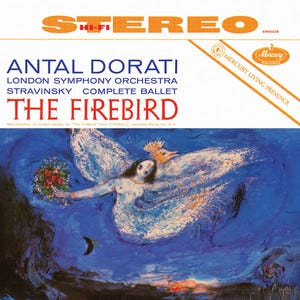
The 1959 recording of the complete ballet for The Firebird with the London Symphony Orchestra conducted by Antal Dorati on Mercury Living Presence (now owned by Decca) is a classic performance which is vividly colorized, energetic, and in spectacular sound for its time. It is an intense reading and captures all the drama perfectly. The wide dynamic range and relatively immediate sound picture from Watford Town Hall in London still sounds magnificent. Pacing is on the brisk side to be sure, but the beauty and poignancy is not missed. In fact, there is a dreamlike quality about the performance which just has that intangible feeling of rightness to it. The astonishingly detailed sound creates an immersive and thrilling experience, and I would not want to be without this classic and essential account.
Recommended Recordings
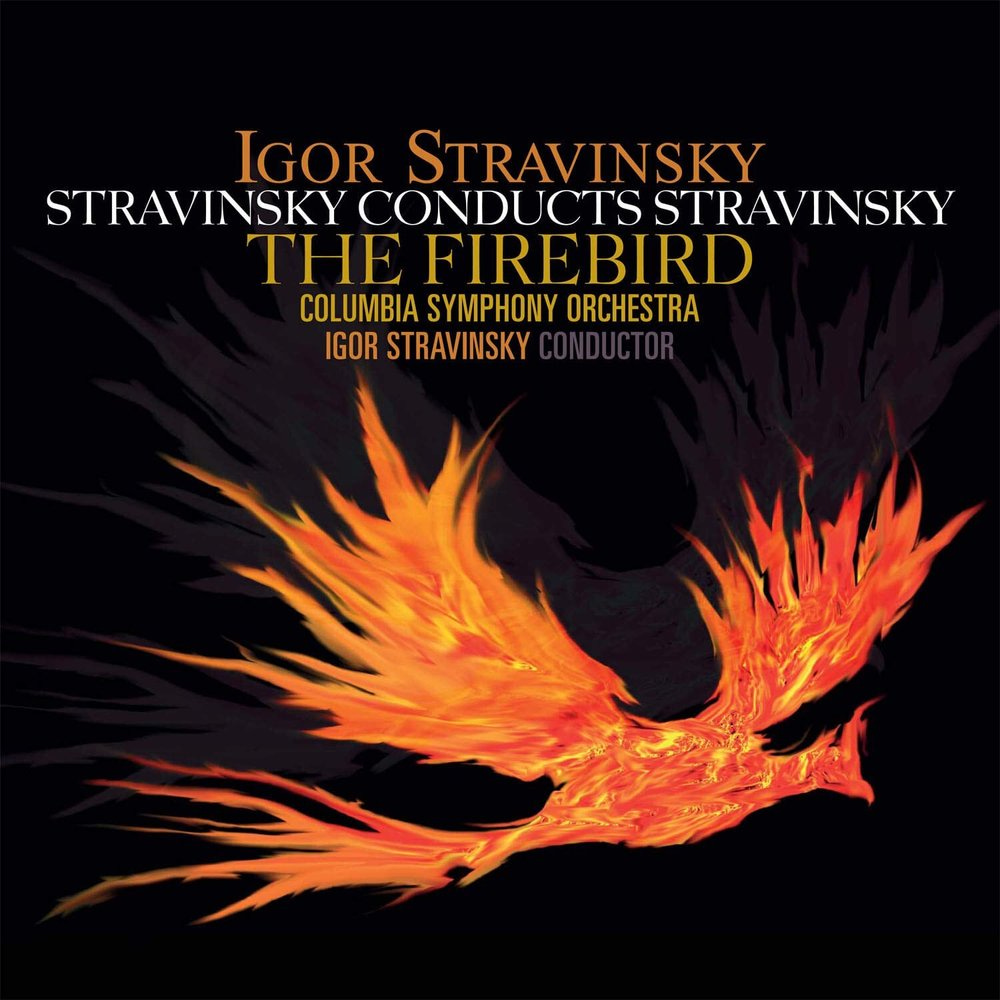
In 1961, Stravinsky himself recorded The Firework complete version with the Columbia Symphony Orchestra, now on the Sony label. Stravinsky was actually a very good conductor of his own music, and this performance runs a close second to the Dorati recording above. Textures are clear, rhythms are clear and precise, and the sound quality is excellent. Stravinsky pays close attention to the dynamics as you might imagine and also pulls out quite a lot of color and detail. His vision of how the Infernal Dance should go is not quite as hair-raising as some other versions, but the reading as a whole is authoritative and highly recommended.
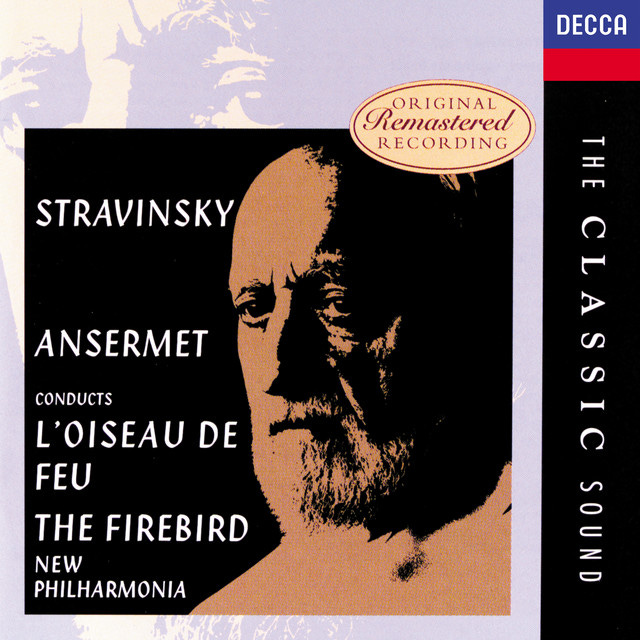
Moving ahead to 1968, we have the excellent late career recording by Ernest Ansermet and the New Philharmonia Orchestra on Decca. Ansermet is rarely found on recordings with orchestras other than the Orchestre de la Suisse Romande, which he founded. But this is a rare treat, with rich and warm sound from Kingsway Hall in London. Ansermet is not rushed here, but the strings and brass are absolutely top notch, and the Decca sound is outstanding as you might expect. Ansermet’s focus on the lyrical aspects of the score pays great dividends, and in his hands we have a sure guide. He eschews playing for effect, or for sonic thrills, but rather he revels in the glories in the score and hews closely to what Stravinsky wrote in the score. It is a beautiful recording, and the sound is certainly better than on most of his Decca records with the OSR. The New Philharmonia also sounds a step above the OSR to me in terms of ensemble and precision.
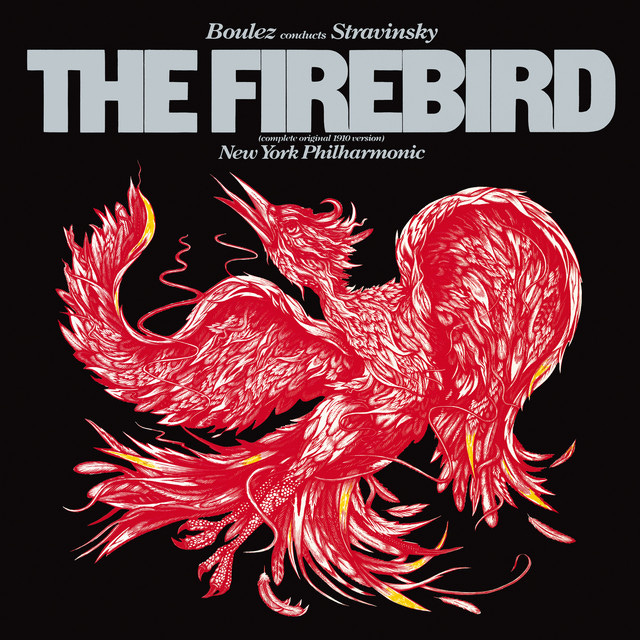
Pierre Boulez was an outstanding Stravinsky conductor; he intuitively understood the composer’s idiom. Boulez’s 1975 recording of The Firebird with the New York Philharmonic on Sony (also on Dutton) has more clarity and energy than his later Chicago recording. The recording was made at Manhattan Center rather than at Avery Fisher Hall, thankfully because the recording has much more presence and detail than I expected. Boulez was known as an objective conductor, but he leads a glittering and persuasive account which never drags. The playing is incisive and direct, and while Boulez misses the last ounce of emotion and tenderness found on Dorati’s and Stravinsky’s versions, this is really terrific. His later recording has a warmer sound, but not nearly the detail, color, energy, or clarity as this one.
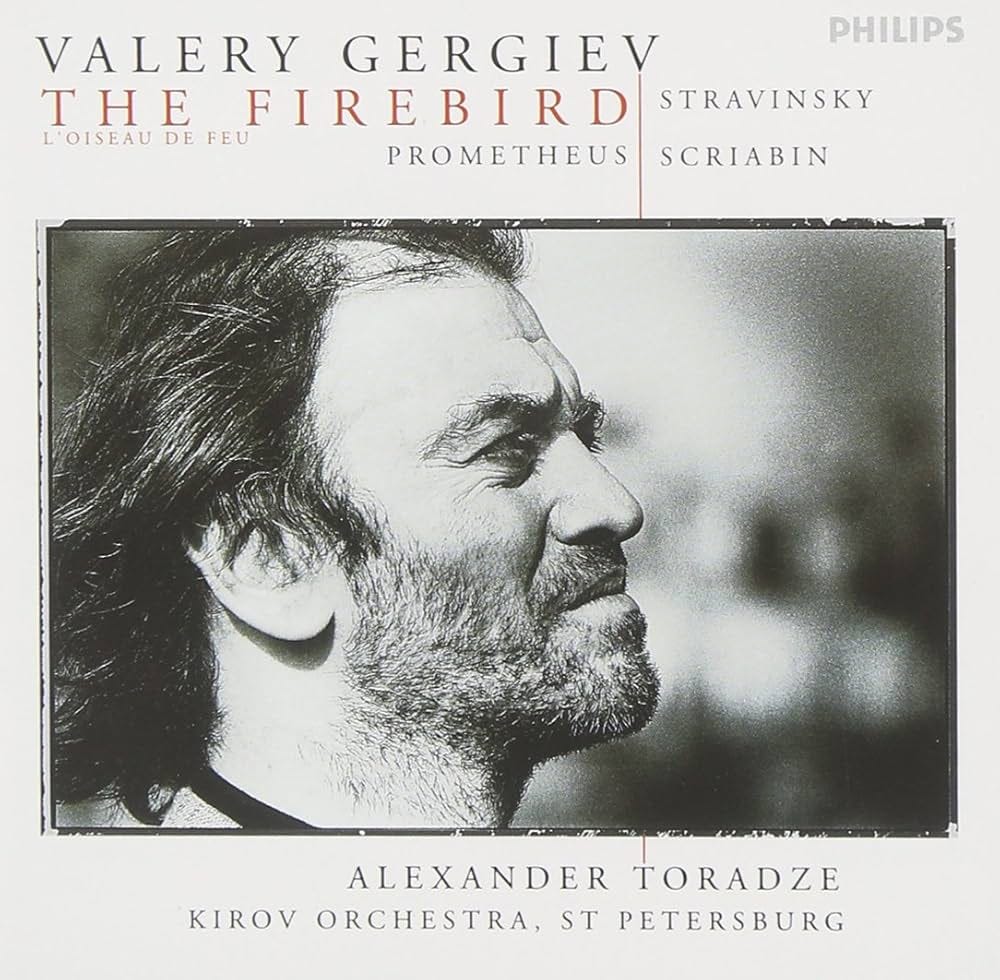
One of the most interesting performances has to be Valery Gergiev’s 1998 recording of The Firebird with the Kirov Orchestra on Philips. There is a visceral quality to this performance and recording which I love, and Gergiev is not afraid to put his own spin on tempos and dynamics. There is plenty of color and drama to spare, and the music comes alive in a way that is rare. The whole performance has a presence about it which demands to be heard, and while Gergiev puts his own touches on it, at no time did I find tempos or phrasing to be too far out of the mainstream. The darkness and light both come out nicely, and the more powerful climaxes are bracing. The sound has lots of detail, but is also balanced well so that the orchestra is placed ideally. I liked this performance much more than I anticipated, but being from the earlier part of Gergiev’s career, I should have known it would have more character, and so it does. Recommended.
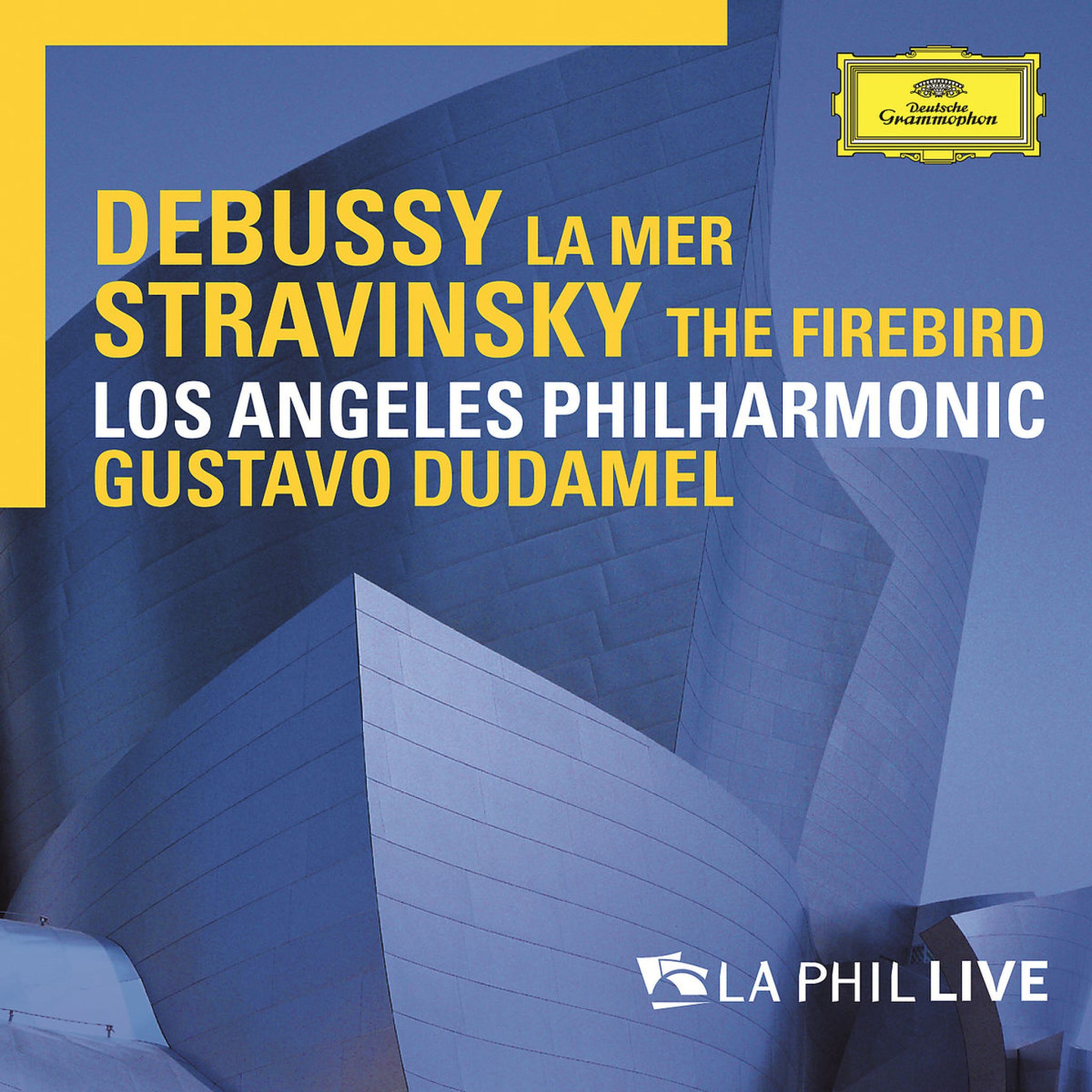
Gustavo Dudamel’s 2012 live recording of The Firebird with the Los Angeles Philharmonic on Deutsche Grammophon is probably one of Dudamel’s finest recordings (and I was extremely remiss for not including it on my Top 75 Conductors profile of Dudamel). Dudamel seems to have the full measure of this score, and the sound is incredibly good. Dudamel proves to be a master at bringing out both the power in stronger passages, but also a lot of color and depth. Details abound, and rhythms are pointed and precise. The textures are bright but also lush and atmospheric. This is a more romantic reading than from Boulez, and is more similar to Ansermet. But in any case, this recording really surprised me in a good way, and I recommend it.
I’m also very impressed with Vasily Petrenko’s extremely well played and recorded version from 2017 with the Royal Liverpool Philharmonic Orchestra on the Onyx label. The sound is excellent, and sonically this is certainly one of the very best recordings of this work. But more than that, the performance has real bite and character to it. The soloists of the Liverpool band are really superb, and I love how Petrenko is able to draw out some of the most subtle details with ease, especially with the wide dynamic range. I like how sensual and rich the textures are, and Petrenko doesn’t rush us through the more beautiful passages. Petrenko shows himself to be an outstanding Stravinsky conductor, and I really can’t say enough about how good this is.
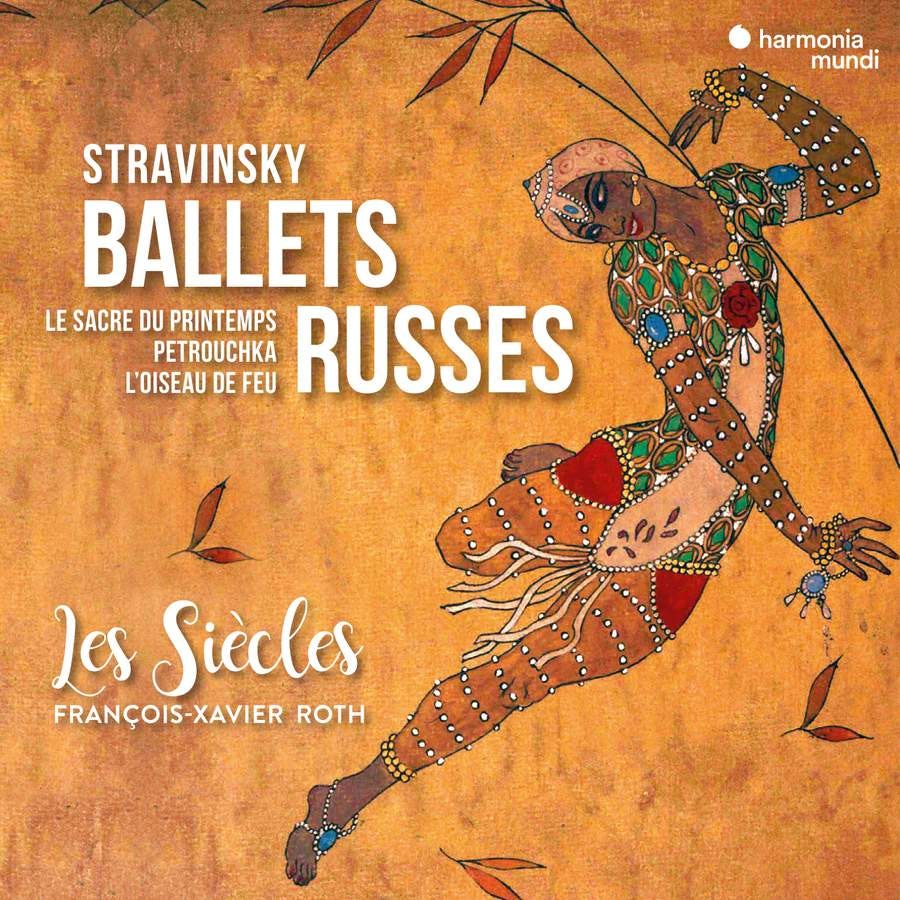
I haven’t liked everything that François-Xavier Roth has done with his orchestra Les Siècles, particularly when it comes to romantic or 20th century fare. But their 2021 recording of The Firebird on Harmonia Mundi is unusually attractive and beautifully played. The transparency in the recording is delightful really, you can hear lots of details, and phrasing feels expansive even at marginally faster tempos. The unique sound of the instruments brings color to the score in a different way than a modern instrument orchestra. Pacing and phrasing are a highlight of Roth’s style. Not everyone will like The Firebird on period instruments, but I found it completely enjoyable.
Finally, there is the live 2022 recording from Esa-Pekka Salonen and the San Francisco Symphony Orchestra on the SFSO’s own label. Salonen has a knack for Stravinsky, and he recorded the complete ballet in 1989 with the Philharmonia. But this one is better both sonically and interpretively in my view. Salonen leans to the cool and clinical side at times, and there are some similarities here with Boulez’s recording listed above. But in this live performance there is more tension and energy, and really more of an emotional range. The live performances from which this album was made were widely acclaimed, and it is easy to see why. The playing is gorgeous, rich, and accented in a way that is irresistible. There seems to be more spontaneity too given the live performance, and that is a plus in this case. The SFSO plays superbly, and the sound quality is outstanding. Recommended.
Other Recordings of The Firebird You Might Enjoy
Paris / Ozawa (EMI/Warner 1972)
Concertgebouw / Colin Davis (Philips/Universal 1978)
Boston / Ozawa (EMI/Warner 1984)
Montreal / Dutoit (Decca 1984)
Birmingham / Rattle (EMI/Warner 1987)
Philharmonia / Salonen (Sony 1989)
Chicago / Boulez (DG 1992)
SFSO / Tilson Thomas (RCA 1999)
Concertgebouw / Jansons (RCO 2008)
Bergen / Litton (BIS 2010)
CBSO / Nelsons (Orfeo 2010)
LSO / Gergiev (LSO Live 2016)
LSO / Rattle (LSO Live 2017)
Paris / Mäkelä (Decca 2022)
LPO / Jurowski (LPO 2022)
Thank you once again for your readership and support! I hope you can join me next time for #111 on the survey, Schubert’s song cycle Winterreise. See you then!
_____________
Notes:
Au, Susan (1998). “Firebird, The”. In Cohen, Selma Jeanne (ed.). International Encyclopedia of Dance. Vol. 3. New York: Oxford University Press. pp. 1–4. ISBN 978-0-19-517587-5.
Beaumont, Cyril W. (1981). Michel Fokine and His Ballets. New York: Dance Horizons. ISBN 978-0-87127-120-4.
Bazayev, Inessa (2020). “Stravinsky’s Sphere of Influence: Paris and Beyond”. In Griffiths, Graham (ed.). Stravinsky in Context. Cambridge: Cambridge University Press. pp. 109–116. doi:10.1017/9781108381086.016. ISBN 978-1-108-38108-6. S2CID 229402254.
Brooks, Jeffrey (2019). “The Performing Arts: Diaghilev’s Ballets Russes”. The Firebird and the Fox: Russian Culture under Tsars and Bolsheviks. Cambridge: Cambridge University Press. pp. 125–146. ISBN 978-1-108-69589-3.
Caddy, Davinia (2020). “Paris and the Belle Époque”. In Griffiths, Graham (ed.). Stravinsky in Context. Cambridge: Cambridge University Press. pp. 71–79. doi:10.1017/9781108381086.011. ISBN 978-1-108-38108-6. S2CID 229424313.
Canarina, John (2003). Pierre Monteux, Maître. Pompton Plains: Amadeus Press. p. 30. ISBN 978-1-57467-082-0.
Carbonneau, Suzanne (1998). “Fokine, Michel”. In Cohen, Selma Jeanne (ed.). International Encyclopedia of Dance. Vol. 3. New York: Oxford University Press. pp. 14–28. ISBN 978-0-19-517587-5.
Homans, Jennifer (2010). Apollo’s Angels: A History of Ballet. New York: Random House. p. 302. ISBN 978-0-8129-6874-3. Archived from the original on 1 October 2023. Retrieved 30 September 2023.
McFarland, Mark (1994). “’Leit-Harmony’, or Stravinsky’s Musical Characterization in ‘The Firebird’”. International Journal of Musicology. 3. Peter Lang: 203–33. JSTOR 24618812.
Nelson, Karen (Fall 1984). “Bringing Fokine to Light”. Dance Research Journal. 16 (2). Cambridge University Press: 3–12. doi:10.2307/1478716. JSTOR 1478716. S2CID 190676916.
Slonimsky, Nicholas (2002). Slonimsky’s Book of Musical Anecdotes. New York: Routledge. p. 197. ISBN 978-1-135-36860-9. Archived from the original on 27 July 2023. Retrieved 16 July 2023.
Stravinsky, Igor (1962). An Autobiography. New York: W. W. Norton.
Stravinsky, Igor; Craft, Robert (1962). Expositions and Developments. Berkeley: University of California Press. OCLC 1224278833.
Taruskin, Richard (1996). Stravinsky and the Russian Traditions: A Biography of the Works Through Mavra. Berkeley: University of California Press. ISBN 978-0-520-07099-8.
Walsh, Stephen (1999). Stravinsky: A Creative Spring: Russia and France, 1882-1934. New York: Alfred A. Knopf. ISBN 978-0-679-41484-1.
White, Eric Walter (1979). Stravinsky, The Composer and his Works (2nd ed.). Berkeley: University of California Press. ISBN 978-0-520-03983-4.
https://www.goodreads.com/author/quotes/8280.Igor_Stravinsky?scrlybrkr=e9ebcefe
https://en.wikipedia.org/wiki/The_Firebird?scrlybrkr=e9ebcefe#
Stravinsky played a critical role in establishing the reputation of my hometown opera: the wonderful Santa Fe Opera. He considered Santa Fe a second home and conducted many performances at the Opera and the St Francis Cathedral throughout the late 50s and early 60s. My favorite opera house made possible by one of my favorite composers!
A great bargain: Nagano, LSO, Virgin