Building a Collection #103: Johann Strauss II's Die Fledermaus
With recommended recordings

Building a Collection #103
Die Fledermaus (“The Bat”)
By Johann Strauss, jr. (Johann Strauss II)
____________
“Happy is he who can forget what cannot be anymore changed.”
-Johann Strauss, jr.
We have reached #103 on our list of the Top 250 Classical Works of All-Time. Remember we are counting upwards, we are not even halfway there! But the hit parade keeps marching, this time with Johann Strauss, jr.’s extraordinarily tuneful and exuberant operetta Die Fledermaus (The Bat), one of the most popular operettas of all time. Although sometimes considered “light opera”, it has been and continues to be performed by major opera companies worldwide.
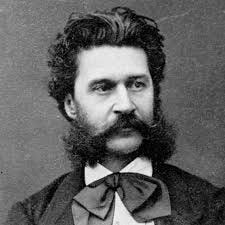
Johann Strauss II
Johann Strauss jr. (also known as Johann Strauss II) was born in 1825. Johann’s father Johann sr. (also known as Johann Strauss I), already a famous Austrian composer of waltzes, polkas, and galops, was not much interested in being a parent, but on one thing he was clear. None of his children were to become professional musicians. Johann jr. discovered he had musical talent, but feared his father’s dictate so much that he had to take lessons secretly.
Rather scandalously, his father took up with another woman and had to move out of the house. However difficult it may have been on his mother, this was actually fortunate for Johann jr. By the time of his father’s death in 1849, Johann jr. was already well on his way to becoming an established professional musician to his father’s chagrin. In fact, it was all the talk in Vienna when, at the age of 19, Johann jr. decided to actually compete against his father. He engaged a concert hall, and a review the next morning in a Vienna paper said, “Good night Lanner. Good evening, Father Strauss. Good morning, son Strauss.” Eventually the son and father reconciled, and when the father died, junior took over his father’s orchestra. Johann jr. would come to lead no fewer than six different orchestras at the same time, and it became a huge business to say the least.
In the 1860’s, Johann II turned to mostly composing. During this time he composed his most beloved waltzes, marches and polkas which included: Accelerations, Perpetuum Mobile, Emperor Waltz, Tales from the Vienna Woods, Voices of Spring, Vienna Blood, Artist’s Life, Morning Papers, and the world renowned On the beautiful blue Danube. These works are more than mere dance numbers or light entertainment, but deserve to be counted among the greatest masterpieces and tone poems in classical music in my opinion. They are sophisticated, sometimes elaborate, always melodic, and carry an optimism that is palpable. Even Brahms became a huge fan of Strauss II, as did Berlioz and Richard Strauss.
Strauss II also became a prolific composer for the stage, writing many operettas. However, only two of them became mainstays, Die Fledermaus (The Bat) and Die Ziegeunerbaron (The Gypsy Baron). They contain some of his most brilliant music. My own personal favorite Strauss II piece is the Overture to Waldmeister, an operetta which did not gain the same popularity as the other two above.
Johann Strauss II came to the United States in 1872, when he was invited to participate in the Peace Jubilee in Boston. He was to be paid an enormous amount of money ---$100,000---to conduct fourteen performances of his Blue Danube waltz. As it turns out, Strauss ended up conducting all the performances with a gigantic orchestra of over a thousand musicians. While the musical result was less than encouraging, it still did a lot to enhance his reputation around the world. Soon he became incredibly wealthy and was truly the “Waltz King”.
Die Fledermaus
It could be argued there is nothing more “Viennese” than the operetta Die Fledermaus, and since the year 1900 it has been performed on New Year’s Eve at the Vienna State Opera. Yet, at the time of its creation things were hardly elegant in Vienna. While Vienna was certainly one of the premier cities in Europe in the middle of the nineteenth century, and was recognized as one of the most important cultural and artistic centers in the world, on May 9, 1873 the Austro-Hungarian Empire suffered a devastating stock market crash. Some lost their fortunes overnight, and there was severe belt-tightening across the empire.
Die Fledermaus is based on a 1872 French vaudeville play, Le Réveillon, by Henri Meilhac and Ludovic Halevy, which is itself based on Das Gefängnis (1851) by Richard Benedix. Karl Haffner made a German version of Le Réveillon and sold it to Max Steiner, the director of the Theater and der Wien. Steiner subsequently gave the manuscript to librettist Richard Genée, telling him that maybe he could make a libretto out of it. Genée contacted Johann Strauss jr. and they began working on it together. Strauss reportedly completed the vast majority of music for the operetta in just 42 days, and the premiere took place on April 5, 1874 (Easter) at the Theater an der Wien.
Die Fledermaus was ideal for the austere times, being relatively compact in three acts and needing only three stage sets. The need for a chorus is minimal, and the premiere featured the performers dressed in regular public attire rather than elaborate costumes. The story was set in the present day Vienna. The story is replete with showing the world as it was before the economic crisis, complete with masked balls, champagne flowing, and plenty of revelry. Audiences enjoyed the chance to celebrate alongside the performers as an escape from the dismal conditions at the time.
But more than anything else, the star of the show is Strauss’ sophisticated, elegant, and tuneful music which was consistently at a far higher level than any operetta up to that point. After the Vienna premiere, the operetta was soon performed in New York, Munich, London, and Paris. At times the work was adapted to the language where it was performed, and indeed it was not performed in German in London until 1895. Around that time, Gustav Mahler raised the status of the operetta by conducting it at the Hamburg Opera, and since that time it has become common for large opera houses to produce the work.
The roles in the operetta are as follows:
Gabriel von Eisenstein - tenor/baritone
Rosalinde, Eisenstein’s wife - soprano
Adele, Rosalinde’s maid - coloratura soprano
Ida, Adele’s sister - soprano
Alfred, a singer-teacher - tenor
Dr Falke, a notary - baritone
Dr Blind, a lawyer - tenor
Frank, a prison governor - baritone
Prince Orlofsky, a Russian prince - mezzo-soprano
Yvan, the prince’s valet - speaking role
Frosch, a jailer - speaking role
Party-goers and servants at Prince Orlofsky’s (chorus)
The role of Eisenstein was originally written for a tenor but is now frequently sung by a baritone. The role of Orlofsky is a trouser role, usually performed by a mezzo-soprano, sometimes by a countertenor and occasionally, at an octave lower, by a tenor.
The operetta is essentially a farcical comedy full of mysterious identities, absurd situations, and some of the most sumptuous and catchy music in all of classical music.
Below is the synopsis of the operetta as provided by The Metropolitan Opera:
ACT I
Vienna, New Year’s Eve, 1899. Outside the Eisensteins’ apartment, the tenor Alfred serenades his old flame Rosalinde, who is now married to Gabriel von Eisenstein. Adele, Rosalinde’s chambermaid, wonders how to get the night off to attend a glamorous New Year’s Eve ball to which her sister has invited her. She tells her mistress she must visit a sick aunt, but Rosalinde refuses to let her go. Alfred appears and declares his love to Rosalinde, who resists him until he begins to sing. Hearing someone coming, she sends Alfred away, but not before he has convinced her to let him return later. Eisenstein and his lawyer, Blind, arrive from a session in court: Eisenstein has been sentenced to eight days in jail for striking a police officer and must begin his term that very night. He furiously dismisses Blind. His friend Falke urges Eisenstein to delay going to jail until morning and instead join him at the ball, which is being given by the wealthy Prince Orlofsky. Falke tells Eisenstein to bring along his infamous pocket watch to charm the ladies. While Eisenstein changes, Falke invites Rosalinde to the ball as well, telling her that if she comes in disguise, she’ll be able to observe her husband flirting with other women. Rosalinde at first doesn’t like the idea but changes her mind when Eisenstein reappears in evening dress. She joins Adele in a bittersweet farewell as her husband heads off to “prison.” Angry at Eisenstein’s deception, she then tells Adele to go see her “aunt” and receives the ardent Alfred. Their rendezvous is interrupted by the prison warden Frank, who has come to arrest Eisenstein. Rosalinde persuades Alfred to preserve her good name by posing as her husband, and Frank carts Alfred off to jail.
ACT II
In the ballroom of Prince Orlofsky’s villa, the guests gossip about their host, who has a habit of paying someone to try to make him laugh—usually in vain. Orlofsky doubts that Falke’s promised evening of entertainment will brighten his spirits, but proclaims his guests should behave however they want and do anything they like. Adele arrives—to the surprise of her sister Ida, a dancer in a hit musical show, who claims she never invited her. Ida worries Adele isn’t classy enough to attend the ball, so they decide to present her as a Russian actress named Olga. Eisenstein enters, posing as a Frenchman, per Falke’s instructions. He immediately identifies Adele as his wife’s maid, but she laughs him off. Frank is also posing as a Frenchman, and he and Eisenstein become fast friends. Frank is so smitten with Ida and “Olga” that he pretends to be a theatrical producer to impress them. Finally Rosalinde arrives, disguised as a Hungarian countess. Angry to spot her husband flirting with her maid, she sings an impassioned ode to her betrayed homeland. When a smitten Eisenstein starts flirting with her, she manages to steal his pocket watch. Midnight is approaching, and Falke entertains the guests with the story of how he earned the nickname of Dr. Fledermaus: one drunken evening, when he was dressed as a bat for a costume ball, his best friend Eisenstein played a practical joke on him that made him the laughingstock of Vienna. The crowd toasts drink, love, and brotherhood until the stroke of midnight, when the new century begins. The guests dance through the night. As the clock strikes six, Eisenstein, whose attempts to retrieve his watch from Rosalinde have failed, rushes off to jail.
ACT III
Frosch the jailer is vexed by the late arrival of his boss, Frank, and by the nonstop singing of Alfred in cell number 12. Frank finally appears, tipsy and enraptured by memories of his magical evening posing as an impresario. Ida and Adele arrive, per Falke’s instructions. Adele hopes Frank might further her stage aspirations. Frank sends them off and then admits Eisenstein, who says he has come to serve his sentence. He is surprised to learn his cell is already occupied by a man who claims to be him and who was found in his apartment with Rosalinde. Blind arrives, claiming he was summoned by the man in cell 12 to handle a case of false arrest. Determined to get to the bottom of the matter, Eisenstein snatches Blind’s cloak, glasses, and wig to disguise himself as the lawyer and confront the impostor. At that moment, Rosalinde rushes in. She tries to secure Alfred’s release and asks “Blind” to press divorce charges against her errant husband, but is offended when the “lawyer” seems to take Eisenstein’s side. Dropping his disguise, Eisenstein accuses his wife of promiscuity, at which point Rosalinde produces his watch. Both lament the impasse at which they’ve arrived, admitting that divorce would be a shame, since they really do love each other. Falke arrives to gloat over the success of his plan—only to find the couple falling into each other’s arms and to discover Adele, Frank, and Frosch happily embarking on new careers. As Falke bemoans that all his efforts were in vain and his life is a failure, Orlofsky arrives with his guests in tow just in time to hear the story—and breaks into hysterical laughter. All sing a final paean to the joys of champagne.
One of my most enjoyable memories of visiting Salzburg years ago was seeing Die Fledermaus at the renowned Salzburg Marionette Theatre. It was tons of fun, and the music of Johann Strauss II always puts me in a good mood. The melodic invention is unique and sparkling, and this has been one of my favorite works for many years.
Recommended Recordings
In my recommendations below, I have kept to complete musical versions (some have the dialogue, some don’t) and I am confining the list to German language versions only.
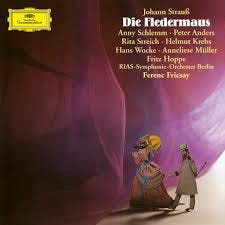
The oldest complete recording of Die Fledermaus I recommend is from 1949 with conductor Ferenc Fricsay and the RIAS Symphony Orchestra Berlin on Deutsche Grammophon (but in slightly better sound on Audite). First, the mono sound is quite good for 1949, which makes you sit up and pay attention. There is some moderate congestion and distortion in climaxes, but not enough to spoil anything. If you have read my reviews, you will know I hold Fricsay in the highest regard, and his early death as a huge loss for the musical world. The overture is relaxed but with wonderful lilt and character. Fricsay was an outstanding Strauss conductor, and his direction and the orchestra’s playing is a joy. The soloists include Peter Anders, Anny Schlemm, Helmut Krebs, Edwin Heyer, Herbert Brauer, Rita Streich, Anneliese Müller, Hans Wocke, Fritz Hoppe, and Silvia Menz. Dialogue is included if that is important to you. Rita Streich’s Adele is ideal, Peter Anders is an animated Eisenstein, and Anneliese Müller’s Orlofsky is very effective. Anny Schlemm as Rosalinde is also terrific. Recommended.

Another historic recording from 1950, just a year later, is with Clemens Krauss and the Vienna Philharmonic and Vienna State Opera Chorus. It has been on various labels, but probably most found on Naxos, Nimbus, and Decca Eloquence. It might make a difference to you which label you hear it on, as the additional tracks at the end vary by label. The Fricsay recording has marginally better sound (the Krauss has thin sound, though the singers are captured quite well), but on performance grounds they are both very good. The soloists are Julius Patzak, Hilde Gueden. Anton Dermota, August Jaresch, Alfred Poell, Wilma Lipp, Sieglinde Wagner, and Kurt Preger. This is a wonderful recording, a classic for good reason, it just captures that intangible Viennese feeling in an unmatched way. Although no dialogue is included, the music sparkles wonderfully, and there is much joy in listening. Anton Dermota is splendid as Alfred, and opens the performance sounding solid and mellifluous. Wilma Lipp may be the finest Adele ever, and Güden is a terrific Rosalinde. Sieglinde Wagner as Orlofsky is an interesting, but entirely successful choice. I like Julius Patzak as Eisenstein as well, a reliable voice with great dramatic abilities. This set is a joy from start to finish.
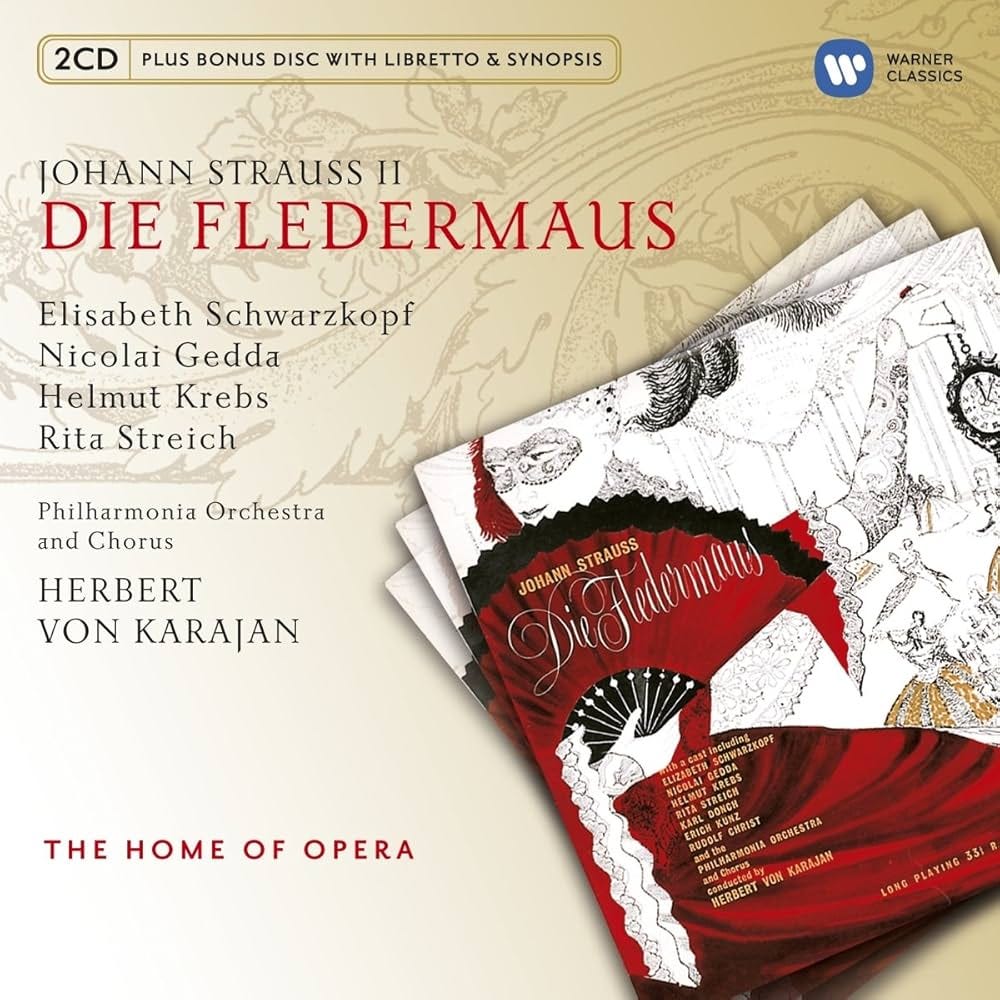
Herbert von Karajan is not always my favorite conductor, but his two recordings of Die Fledermaus are both recommended. First is his 1955 mono recording for EMI (now Warner, also on Naxos) with the Philharmonia Orchestra and Chorus. The cast includes Nicolai Gedda, Elisabeth Schwarzkopf, Helmut Krebs, Erich Majkut, Erich Kunz, Rita Streich, Rudolf Christ, Karl Dönch, Franz Böheim, and Luise Martini. While the two leads, Gedda as Eisenstein and Schwarzkopf as Rosalinde, are starry names, not everyone warms to their voices. However, here they are at their best. Krebs and Kunz are also excellent, and Streich reprises Adele superbly. Karajan is a bit hard-driven here, and the reading lacks some charm. But that is more than compensated for by the excitement and outstanding singing. The mono sound is a bit distant for my tastes, but perfectly fine.
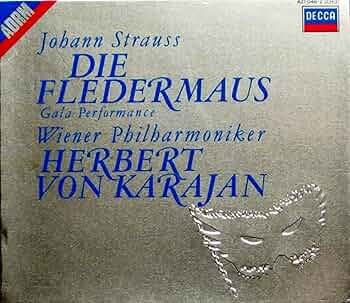
Karajan recorded Die Fledermaus again in 1960, this time with the Vienna Philharmonic and Vienna State Opera Chorus for Decca. The cast includes Waldemar Kmentt, Hilde Gueden, Giuseppe Zampieri, Peter Klein, Walter Berry, Erika Köth, Regina Resnik, Eberhard Wächter, Erich Kunz, and Hedwig Schubert. Karajan is a bit more relaxed here, and of course it helps to have the VPO playing Strauss. Gueden is sultry and charming, Köth is well accented, Berry and Wächter are Vienna regulars in good voice, and Kmentt and Zampieri come through quite well. Kunz and Resnik are convincing in their roles as well. It is a starry cast, made even more starry with the Gala Concert with contributions from many opera stars under contract with Decca at the time: Renata Tebaldi, Fernando Corena, Birgit Nilsson, Mario del Monaco, Teresa Berganza, Joan Sutherland, Jussi Björling, Leontyne Price, Giulietta Simionato, Ettore Bastianini and Ljuba Welitsch. The Gala alone makes this a unique recording, but the entire set sparkles with wit and personality. The sound is in stereo with dialogue included. It has been remastered by Pristine, with improved sound, but the Pristine release does not include the Gala performances.
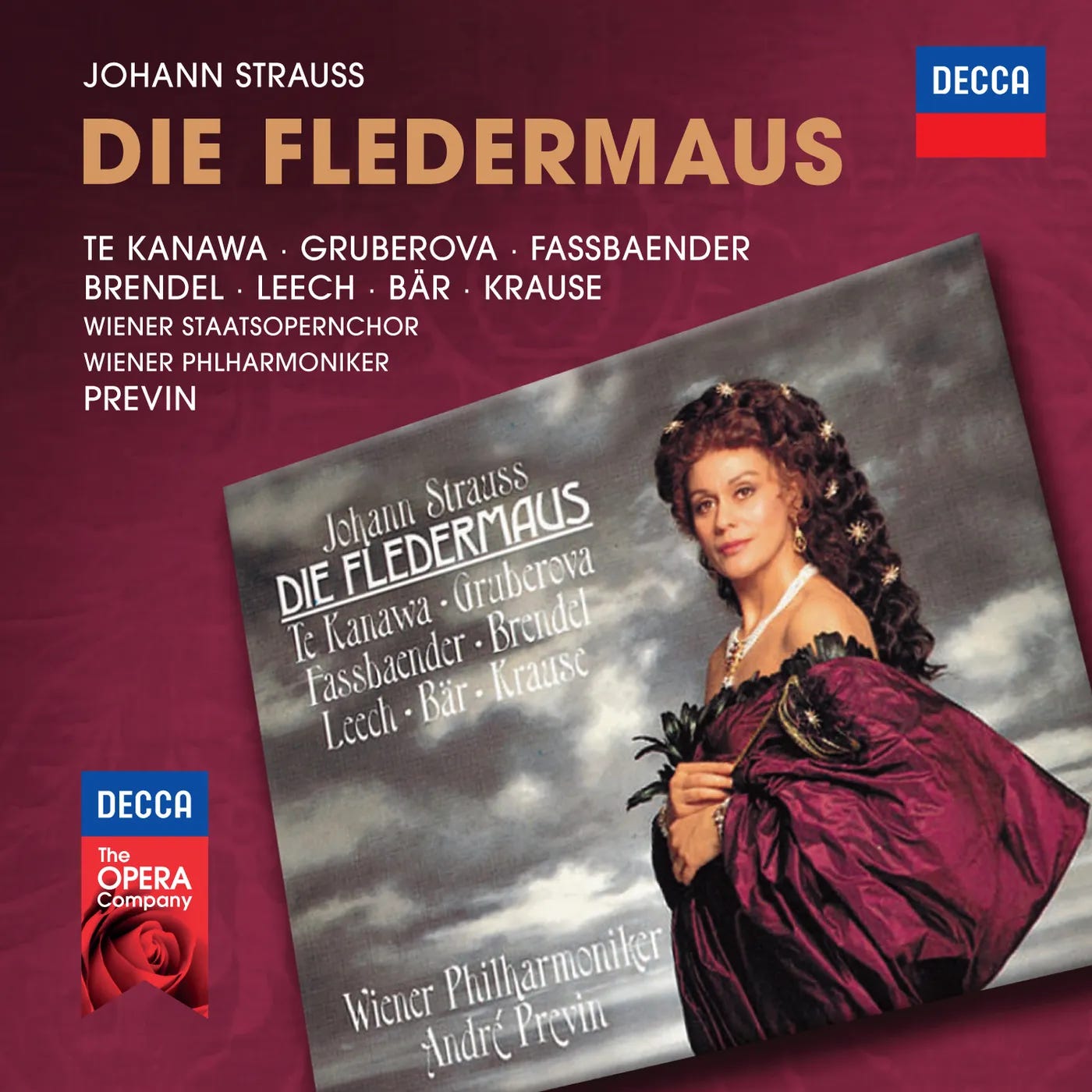
We now jump ahead to the absolutely superb 1990 digital recording from André Previn in his prime leading the Vienna Philharmonic Orchestra and Vienna State Opera Chorus on the Philips (now Decca) label. This is easily the finest Die Fledermaus of the digital era, and of course we have the rich and warm tone of the VPO. The starry cast includes Wolfgang Brendel, Kiri Te Kanawa, Richard Leech, Anton Wendler, Olaf Bär, Edita Gruberová, Brigitte Fassbaender, Tom Krause, Otto Schenk, and Karin Göttling. Te Kanawa as Rosalinde is completely ravishing, and Brendel as Eisenstein is ideal with his light baritone. Fassbaender is probably the finest Orlofsky on record, and while Gruberová as Adele is very good, some may find her voice grating. I think this is one of her best performances. Previn’s direction is relaxed, but quite idiomatic and charming and the sound is very good as well. The set is a pleasure from first to last.
Other Die Fledermaus Recordings You Might Enjoy
While I initially thought I would include the Kleiber recording in the recommended list above, unfortunately the Orlofsky of Ivan Rebroff is disqualifying for the entire set for me. But you may feel differently. The recordings below all have some great assets, and you may prefer them to some I have listed above.
Philharmonia Orchestra & Chorus / Otto Ackerman (EMI/Warner 1959)
Vienna State Opera Orchestra and Chorus / Oscar Danon (RCA 1964)
Vienna Symphony Orchestra and Vienna State Opera Chorus / Willi Boskovsky (EMI/Warner 1971)
Vienna Philharmonic Orchestra and Vienna State Opera Chorus / Karl Böhm (Decca 1971)
Bavarian State Opera Orchestra and Chorus / Carlos Kleiber (DG 1976)
WDR Rundfunkorchester and Rundfunkchor Köln / Friedrich Haider (Capriccio 2011)
Join me next time for #104 on our survey, Richard Wagner’s opera Parsifal. See you then!
______________
Notes:
The Metropolitan Opera. Synopsis of Die Fledermaus. Found online at www.metopera.org.
Moore, Ralph. Johann Strauss II’s Die Fledermaus: A survey by Ralph Moore. December 13, 2023. Found online at https://musicwebinternational.com/2023/12/johan-strauss-iis-die-fledermaus/
Palmer, John. Johann Strauss II. Die Fledermaus. The All Music Guide to Classical Music. Chris Woodstra, Gerald Brennan, and Allen Schrott editors. Backbeat Books. San Francisco. 2005. Pp. 1317-1318.
The Observer, 4 May 1930, p. 14: interview with ROH archivist Richard Northcott in connection with revival of Die Fledermaus conducted by Bruno Walter.
https://en.wikipedia.org/wiki/Die_Fledermaus?scrlybrkr=40ad99ec#
https://en.wikipedia.org/wiki/Johann_Strauss_II?scrlybrkr=40ad99ec
I adore Johann Strauss. Waltzes are my favourite. My favouritea by him are Accelerationen and The Emperor Waltz. My favourite recordings are by Lorin Maazel. I have a cd compilation of the New Years concerts taken from the early 80s concerts I believe. The quality is astounding. The studio recordings of those waltzes sound flat by comparison. I only have one recording of Die Fledermaus it's by Robert Stolz. It's the full version with the dialogue unfortunately. My Lorin Maazel CD does have the overture on it and it's wonderful.