Building a Collection #100: Shostakovich's Symphony no. 5
With recommended recordings

Building a Collection #100
Symphony no. 5 in D minor, Op. 47
By Dmitri Shostakovich
________________
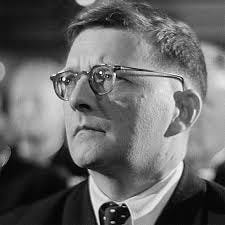
Editorial note: please note this is one of my longest posts ever, which is saying something since most of my posts in this series have been lengthy. I do apologize, but this must be the case to properly cover the topic and to be as thorough as possible with recording recommendations.
Happy New Year! I hope this finds you feeling optimistic about 2026, and just remember if the world continues to crumble, at least we have some great music to help keep us sane! At number 100 in our survey is the first entry by one of the most significant composers of the twentieth century, Soviet-era Russian composer Dmitri Shostakovich. The work is his tremendous Symphony no. 5, one of the composer’s best known and most loved works. It is impossible to separate Shostakovich’s music from the time and place in which he lived and composed, and while the music itself is wonderful, we must understand the political environment from which it emerged. But we will get to that.
Dmitri Shostakovich (1906 - 1975)
Dmitri Dmitriyevich Shostakovich was born in 1906 in Saint Petersburg, Russia, then under the Russian Empire. Dmitri’s forebears were Siberian, Polish, and Lithuanian. His father was an engineer in Saint Petersburg. His mother began to teach Dmitri the piano when he was 9 years old, and he showed immediate talent. Indeed, he had the ability to play from memory what he learned at the previous lesson.
In 1919 at the age of 13, Dmitri gained admittance to the Petrograd Conservatory, then directed by the composer Alexander Glazunov, and Glazunov would play an important role in recognizing the young man’s ability. At the conservatory, Dmitri would study piano, counterpoint, and composition, as well as music history. In 1925, Dmitri enrolled in conducting classes and conducted the conservatory’s orchestra. He gained a reputation as a deeply intuitive and imaginative musician, and his classmates and professors became quite fond of his style.
It was also 1925 when his own music was first played in Moscow, a disappointing experience for Shostakovich since the critical reception was cool. He decided to stay in Moscow, and continue composing. The piece that first brought Shostakovich to a larger audience was his Symphony no. 1 which was written as his graduation piece from the conservatory. After the advocacy from some friends and professors, the work was brought to the attention of his conducting teacher Nikolai Malko, and he agreed to conduct the premiere with the Leningrad Philharmonic Orchestra. The premiere was given on May 12, 1926 in Leningrad, and it was warmly received by audiences and critics. Shostakovich embarked on a dual career of pianist and composer and he would continue performing as a concert pianist until 1933, but thereafter he would only perform his own works. He did, however, participate as a Soviet contestant at the inaugural International Chopin Piano Competition in 1927. Reports of Shostakovich’s style on the piano indicate that his playing was dry, unsentimental, structured, disciplined, and rhythmically impulsive. Ultimately Shostakovich did not win a prize at the competition, and that year Lev Oborin won first prize.
After the competition, while in Berlin traveling with Oborin, Shostakovich met the conductor Bruno Walter and Walter was very impressed with the young man’s Symphony no. 1, and he would later conduct it often. Leopold Stokowski gave the American premiere of the symphony in Philadelphia, and made the first recording of the work. Shostakovich’s next symphony, his Symphony no. 2, was written in 1927 and contained more patriotic and modern elements which led to it not gaining as much popularity. Around this time, Shostakovich befriended musicologist and critic Ivan Sollertinsky, and Sollertinsky was to have a significant influence on Shostakovich, especially when it came to appreciating composers such as Brahms, Mahler, and Bruckner. This led to a period where Shostakovich would begin to explore music going all the way back to Bach and how tradition influenced modern music.
Shostakovich ventured into opera at this time as well, and while his first opera titled The Nose from 1930 was mercilessly reviled by the musicians and critics and panned as incomprehensible, his next opera Lady Macbeth of Mtsensk from 1934 was much more successful and, at least initially, widely praised by the Soviet authorities. It was described as “the result of the general success of Socialist construction, of the correct policy of the Party”, and as an opera that “could have been written only by a Soviet composer brought up in the best tradition of Soviet culture”.
But that praise would soon change. After Joseph Stalin attended the opera on January 26, 1936, a performance Shostakovich was urged to be present for, Stalin and his entourage silently left the theater without comment. It was widely reported that the composer was “white as a sheet” when he went on stage to take a bow. Two days later, while Shostakovich was touring, the official Soviet newspaper Pravda published a review (unattributed) of the concert which was famously titled Muddle Instead of Music: On the Opera Lady Macbeth of the Mtsensk District which derided the opera as “coarse”, “vulgar”, and “bourgeois”, and further a “cacophony” of “nervous, convulsive, and spasmodic music”. The rumor spread that Stalin himself had written the opinion, and while it is unlikely he did, he certainly would have agreed with the article. Suffice it to say that this article changed the trajectory of Shostakovich’s composing career, making him the target of monitoring and possible censorship from the state.
Almost immediately Shostakovich became persona non grata in the eyes of the state, and the opera was eventually banned. Not only that, but the members of the media that had initially praised the opera were forced to retract their support of it, and then publish new statements condemning it. Shostakovich lost almost all his income overnight, as well as losing the support of most of his friends, critics, and colleagues who, understandably, now had to distance themselves from him. The three notable exceptions that still supported him, Isaac Babel, Abram Lezhnev and Vsevolod Meyerhold, were all eventually executed in the coming purges.
At this time in 1936, Shostakovich was getting close to finishing his Symphony no. 4 and had even arranged for the premiere in Leningrad. But some friends warned him against premiering the work since it was redolent of some of Mahler’s works in structure (Mahler was not liked by the party) and in its modern style. Later, Shostakovich was summoned to a meeting of the Union of Soviet Composers and was urged to cancel the premiere and to withdraw the work. He complied and withdrew the symphony. Symphony no. 4 would thus not be premiered until 1961.
Shostakovich’s response to being denounced was his Symphony no. 5 (1937), which was strikingly more conservative than his other recent works. When it premiered in Leningrad in 1937, it was a huge success and brought many to tears. But what was the meaning behind the music? Did Shostakovich completely capitulate to the authorities, and abandon his own artistic impulses? Or was there a message in the symphony itself that explained Shostakovich’s intent? In his memoir, he stated: “I’ll never believe that a man who understood nothing could feel the Fifth Symphony. Of course they understood, they understood what was happening around them and they understood what the Fifth was about”. More about the Fifth below in the next section.
The Fifth put Shostakovich in good standing again with both critics and the authorities. The same people that had turned their back on him now praised him again for learning from his mistakes, and for becoming a true Soviet artist. In 1937 Shostakovich also began teaching at the Leningrad Conservatory, which provided some much needed financial stability. He also composed his first String Quartet, a format he would frequently use as an outlet for his true emotions and stylistic inclinations, and which gave him more cover than his large scale works.
Shortly after the outbreak of World War II, Shostakovich was commissioned to write a piece celebrating the victorious Red Army as they paraded through conquered Finland. The piece was called Suite on Finnish Themes. But the so-called “Winter War” between the Soviet Union and Finland was a tremendous failure for the Red Army, and the victory parade never happened. Shostakovich did not claim credit for the piece he composed, and indeed it was not performed until 2001. While Shostakovich tried to enlist in the army, he was turned away due to his poor eyesight. He ended up serving in the firefighting brigade from the Leningrad Conservatory and also released a radio address to aid in the war effort.
During the war Shostakovich wrote his Symphony no. 7 “Leningrad”, composing most of it in Leningrad while the city was under siege. When he and his family were evacuated to Kuybyshev, he completed the work. In a radio address on September 17th, 1941, Shostakovich said he continued to write the symphony because it was every citizen’s duty to continue their work to ensure life goes on. He wrote in an article that the symphony was a “symphony about our age, our people, our sacred war, and our victory”. The symphony had its premiere in March 1942 played by the Bolshoi Theatre Orchestra in Kuybyshev, and later that year it was played in London and in the United States.
Shostakovich and family moved to Moscow in 1943, and by that time the Red Army was on the offensive. His Symphony no. 8 was received rather coolly by the Soviet authorities due to its downcast and tragic tone; a symphony briefly nicknamed the “Stalingrad Symphony” by the Western press. Initially, Shostakovich had declared his intention to make his Symphony no. 9 the third of his “wartime” symphonies, but in early 1945 he stopped working on it and shelved it. The partial score was lost until 2003. In the meantime he began work on what would become his actual Ninth, a work that treads lighter in texture and is shorter than previous symphonies. Indeed, it was even joyful, playful, and brilliantly scored. But by early 1946 the symphony was being criticized for being too lighthearted, not serious enough, even childish.
In 1948 Shostakovich was again denounced by the Soviet regime for being too influenced by formalism, and this time he was targeted along with fellow composers Serge Prokofiev and Aram Khachaturian. The Soviets were attempting to root out any semblance of western influence in the music, as well as anything that was not of Russian origin. They wanted music for the masses. Shostakovich was called before the Supreme Soviet Committee and was forced to make public apologies for his compositional choices, his works were banned, and his family’s privileges were taken away. Perhaps most consequentially Shostakovich was dismissed from the Conservatory. At the time the air of suspicion hung over any composer that was perceived to be using formalist techniques.
In order to make a living, Shostakovich began writing film scores, but behind the scenes he was also working on some things that might rehabilitate him again with the authorities, but also some other pieces that he kept hidden such as his Violin Concerto no. 1 and his song cycled From Jewish Folk Poetry. Restrictions eased against Shostakovich in 1949 because Stalin needed him to represent the Soviet Union at the Cultural and Scientific Congress for World Peace in New York. But the experience was humiliating for Shostakovich as he was given a prepared speech to read in front of the press. He couldn’t even get through the speech, and it had to be finished by another representative. When Shostakovich was asked publicly about whether he agreed with the recent denunciation of Stravinsky by the Soviet government, he asserted that he agreed with it, which was obviously not true since Shostakovich admired Stravinsky and was greatly influenced by him.
But what helped Shostakovich’s rehabilitation more than anything was Stalin’s death in 1953. His Symphony no. 10 dates from this time, and it includes a number of recognizable musical quotations, motifs, and themes, and according to some sources the brutal second movement is a portrait of Stalin. The Tenth ranks just below the Fifth in terms of popularity. Shostakovich also published some of the works he had kept hidden, since there was more freedom to do so. In 1956 Shostakovich composed his Festive Overture, a work which was used as the theme for the 1980 Summer Olympics. In 1959 Shostakovich appeared onstage in Moscow after a performance of his Fifth by Leonard Bernstein and the New York Philharmonic while they were on tour. Rather famously Bernstein and the NYPO would go on to record the work later that year in Boston’s Symphony Hall for Columbia records.
A major turning point for Shostakovich, as well as a major point of controversy, came when he joined the Communist Party in 1960. Nikita Khrushchev was looking to build better rapport with artists in the Soviet Union, and he wanted Shostakovich to be the Chairman of the RSFSR Union of Composers. But in order to be appointed, Shostakovich would have to join the party. The decision was agonizing for Shostakovich. Some reports say he was reduced to tears over the decision, and he told his wife he had been blackmailed. One source says he became suicidal at this time due to the stress. Some scholars have argued his decision was the result of cowardice, some say it was political pressure, and yet others say it was his free decision. In any case, he was indeed appointed and served until his death. Serving in the position also meant that he went back to work on a piece which was a homage to Lenin, and this resulted in his Symphony no. 12, “The Year 1917” which is essentially an account of the Bolshevik Revolution.
Shostakovich wrote a very personal, almost autobiographical work at this time which became his String Quartet no. 8. The work contains some musical quotations from his own music, and he confessed that since it was unlikely anyone would write a work dedicated to him, he would just do it himself.
In 1962 Shostakovich wrote his Symphony no. 13 “Babi Yar” which addressed the subject of anti-Semitism. The symphony uses text from a poem by Yevgeny Yevtushenko which commemorates the “Babi Yar” massacre of Soviet Jews during World War II. After the premiere it was pointed out that many Russians and Ukrainians also died alongside the Jews in the massacre, leading Yevtushenko to add another verse.
Later in his life, Shostakovich turned to composing more film scores, with the score for the Russian film Hamlet being particularly fine. He also became rather preoccupied with his own death, and his Symphony no. 14 from 1969 is essentially a song cycle based on poems relating to death. He dedicated the symphony to composer Benjamin Britten, who had become a good friend. In contrast, his final Symphony no. 15 is more of a retrospective, is more approachable, and contains references to music by Wagner, Rossini, and his own works.
According to his daughter, Shostakovich had an obsessive temperament and was obsessed with cleanliness. He would also synchronize all of the clocks in his flat and would often send himself cards to test the efficiency of the Soviet postal service. He was known to be a shy, nervous man, a chain smoker, and always on edge. Shostakovich was known to be generous with his time and advocacy for fellow composers and musicians under the Soviet regime. Finally, he loved football (soccer) and was a big fan of his beloved Zenit Leningrad (now Zenit Saint Petersburg).
Shostakovich was married three times, with his third marriage to the much younger Irina Supinskaya in 1962 seemingly being the happiest of the three. Shostakovich had two children, both from his first marriage, the noted conductor Maxim Shostakovich, and Galina Shostakovich who became a musicologist. In his later years, Shostakovich’s health declined considerably, and he was loath to quit smoking and drinking vodka. From 1958 on he suffered from various maladies such as several heart attacks, several falls in which he broke both legs, and a motor neuron disease in his hands. His death in 1975 in Moscow was diagnosed as either lung cancer or heart failure, and he is buried at Novodevichy Cemetery in Moscow.
Symphony no. 5
We already know that Shostakovich’s Symphony no. 5 was a huge success at its premiere in November 1937, the standing ovation at the premiere lasting more than half an hour. The symphony is in four movements:
Moderato
Allegretto
Largo
Allegro non troppo
What we hear in this symphony is more direct and accessible musical language from Shostakovich, well-constructed melodies, and a rousing fanfare conclusion. Even in its seeming directness, Symphony no. 5 also has a complexity and sophistication which further reveals the genius of the composer. Allegedly, Shostakovich confided to friends that the finale was really a satire of Soviet leader Joseph Stalin, and that the movement is meant to portray a hollow leader dressed in brilliance but surrounded by fake exuberance. The apparently exultant conclusion has been hotly debated in musical circles as to whether it is truly a happy ending, or if Shostakovich intended a deeper, more cynical meaning at the end. There are credible arguments on both sides, but after more recent scholarship it seems the symphony’s finale is meant sarcastically. The truth may depend on who is listening, but we can enjoy the symphony regardless.
In his outstanding article on the symphony, American conductor and composer Kenneth Woods comments on the movements:
I.Moderato
The almost physical impact of the beginning of Shostakovich’s Fifth slightly belies how restrained he is in using the orchestra in the Symphony’s opening paragraphs. As in his Eighth and Tenth symphonies, he begins using only the strings, gradually introducing the bassoons, flutes, oboes and clarinets, and finally, the brass and percussion…in the late 1970’s, the publication of Solomon Volkov’s “Testimony- The Memoirs of Dmitri Shostakovich” brought on heated debate in the West over the official programme of the Fifth. A mirror-image programme, no doubt closer to the truth but still far too one-dimensional, was suggested: that the work was a protest against the Stalinist Terror. In the ensuing decades of often maddeningly reductionist debate, it has been easy to overlook evidence that the work has several programmes. The first of these is suggested by the first movement’s second theme. Soaring and tender in its first incarnation in the violins, and more pained when repeated by the violas, playing in an intentionally cruel register, it is a variation of the work’s opening theme, but also a quote from the Habanera (“L’amour, l’amour”) of Bizet’s Carmen…as with his symphonic idol, Mahler, Shostakovich understood that a symphony could carry a variety of messages and express a range of programmes, from the most public to the most private. This first movement of the Fifth marks an important turning point in his development, wherein he defines and perfects his own, very personal reworking of traditional Sonata form. By reversing the order of themes in the recapitulation, he creates a vast arch form, building in intensity to a climax of apocalyptic intensity, finally disintegrating into tragic resignation. The restraint with which the movement begins and ends is matched by the near hysterical abandon of the movement’s climax. Shostakovich uses tempo to intensify this arch shape, beginning the symphony very slowly, gradually speeding up through the development and then winding down to end at very nearly the same speed as the opening. This design was based to a large extent on the first movement of Tchaikovsky’s Pathetique Symphony, and Shostakovich would use it again in the 7th, 8th and 10th symphonies.
II. Allegretto
The second movement, a rather gruff Ländler shows Shostakovich at his most Mahlerian- mixing charm and venom, elegance and irony in equal measure. The Trio begins as a study in obsequious grace, with the solo violin playing flirtatiously over delicate harp and pizzicato accompaniment, but the music repeatedly loses its cool, descending into noisy violence. The sinister return of the Ländler is surely a nod to the Scherzo of Beethoven’s Fifth, with its skeletal instrumentation of staccato bassoons and pizzicato strings. One last flirtatious nod to the violin solo, this time on solo oboe, disingenuously promises a gentle resolution of the movement’s tensions, before a final angry outburst brings the movement to an abrupt close in A minor.
III. Largo
The extraordinary Largo, written in just three days, is one of Shostakovich’s most moving creations. As in the opening of the first movement, Shostakovich uses the orchestra with tremendous restraint. Again, he opens with a long paragraph for strings, only gradually and sparingly introducing woodwinds and percussion. The brass remain silent throughout. In the second paragraph solo oboe, clarinet and flute each state a theme pregnant with loneliness over nearly static string tremolo accompaniment. Then, Shostakovich begins the inexorable build up to the anguished emotional climax of the entire symphony, a passage the great American musicologist Michael Steinberg calls “the most Tchaikovskian page in all Shostakovich”.
IV. Allegro non troppo
The Finale shatters the rapt stillness of the Largo with a violent and brutish march, the theme of which integrates material from no less than three sources. The first is, again, Carmen, using the music from the Habanera setting the words “Prends garde a tois!” or “Beware! Beware!” Secondly, material from the theme was used again in Shostakovich’s later setting of Robert Burns poem “MacPherson’s Farewell,’ to the words “Sae rantingly, sae wantonly, sae dauntingly gaed he” as the hero is led to “the gallers-tree.” Finally, as Gerald McBurney observed, the first four notes (A D E F) are the same as the first four notes of Shostakovich’s 1936 setting of the Pushkin poem “Rebirth,” wherein the poet describes “A Barbarian artist with sleepy brush”, who “Blackens over a picture of genius.” The parallels with Stalin’s obliteration of Shostakovich’s Fourth Symphony and Lady Macbeth are obvious…ambivalent, angry, triumphant, tortured, heartbroken, defiant, world-embracing and self-regarding, the final page of this greatest of 20th c. symphonies is so powerful for much the same reason it has always been so controversial. When one is able to recognize the depth and intensity of its countless tensions and contradictions, what listener could ever settle for something as simplistic and straightforward as a happy, or sad, ending again?
The official government response to the symphony acclaimed it as a great artist realizing the errors of his ways and returning to greatness by embracing his Soviet personality. But the public reception was rapturous due to the deep emotional connection it represented to the Russian people. After its Moscow premiere, the Russian pianist Heinrich Neuhaus called the symphony:
“deep, meaningful, gripping music, classical in the integrity of its conception, perfect in form and the mastery of orchestral writing—music striking for its novelty and originality, but at the same time somehow hauntingly familiar, so truly and sincerely does it recount human feelings”
In his Symphony no. 5, Shostakovich brought together a more conservative structure, a more harmonic and more tonal sound world, and distinct thematic material that was easier to understand. While it is undeniably authentic to Shostakovich as an artist, it was also written under duress and with a lot at stake. The resulting symphony stands as both a historical statement as well as a landmark piece of 20th century music.
Recommended Recordings
While the recordings from Stokowski, Mravinsky, and Bernstein are my favorites, they are all on the faster side in the outer movements, which Shostakovich himself seemed to favor. But in my recommendations below I tried to leave room for some other interpretations and recordings which just cannot be ignored.
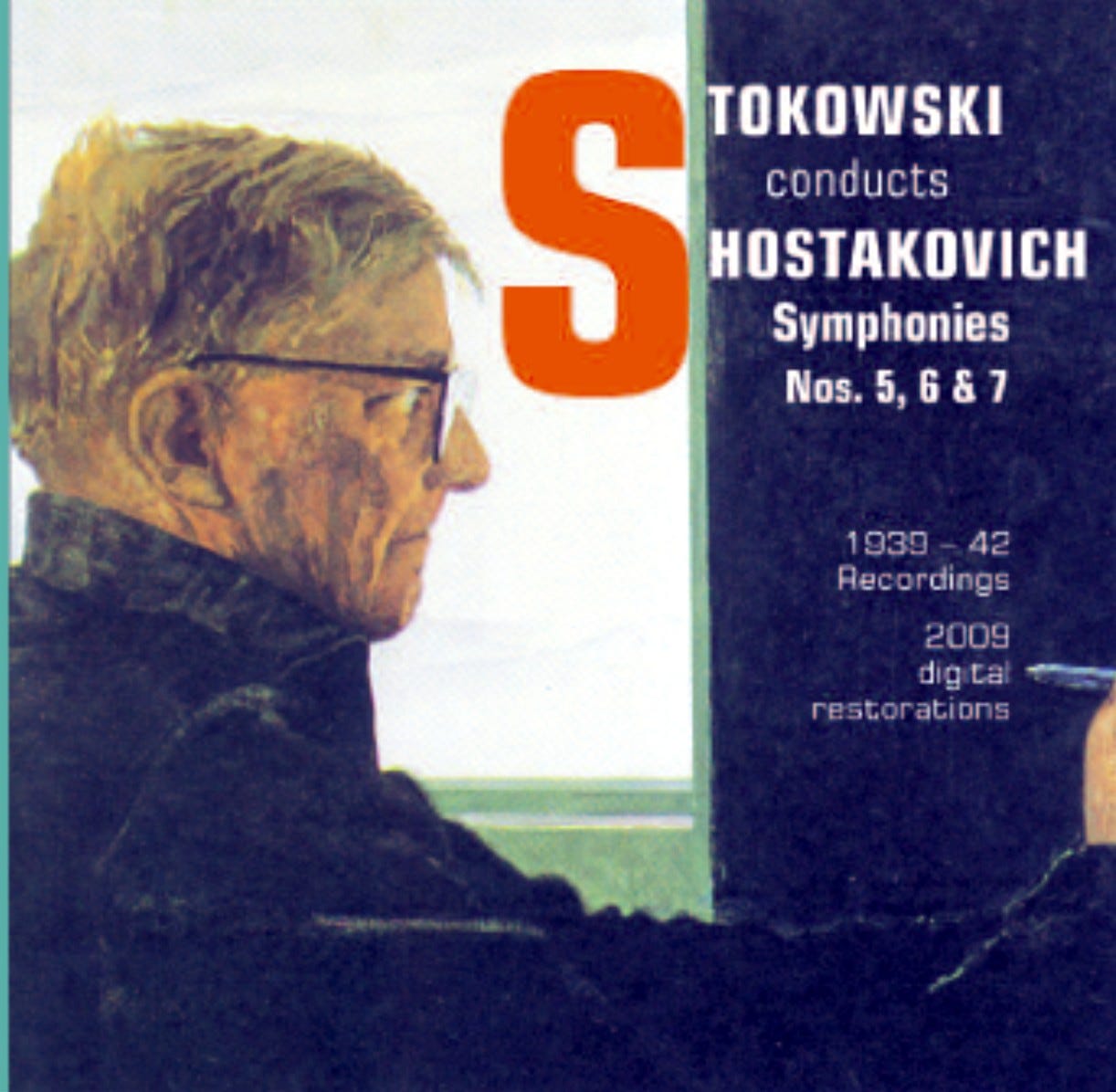
The earliest recording I am recommending is the pioneering commercial recording of this work by Leopold Stokowski and The Philadelphia Orchestra made in 1939 for RCA Victor. This is among the fastest recordings on the list in terms of total timing, and of course allowances have to be made for the sound quality. But what I really like about Stokowski’s direction is how incisive he gets the orchestra to play, and how much passion he is able to draw out. The orchestra plays marvelously too, with energy and complete involvement. The sound is quite refined for 1939, remarkable actually. It really is an electrifying account, although it seems Stokowski and the orchestra make an error at the end of the Largo. Unbelievably, this recording was never transferred after the war until it reappeared in 1991.
![Shostakovich - Artur Rodzinski, The Cleveland Orchestra – Symphony No. 5 – Vinyl (LP, Mono), 1948 [r14667936] | Discogs](https://substackcdn.com/image/fetch/$s_!DNaF!,f_auto,q_auto:good,fl_progressive:steep/https%3A%2F%2Fsubstack-post-media.s3.amazonaws.com%2Fpublic%2Fimages%2Ff5e2b6dd-fb5f-4a84-ba9c-aaa2177c60f6_600x596.jpeg "Shostakovich - Artur Rodzinski, The Cleveland Orchestra – Symphony No. 5 – Vinyl (LP, Mono), 1948 [r14667936] | Discogs")
Despite a regrettable cut in the finale by the conductor, the 1942 recording by Artur Rodzinski and the Cleveland Orchestra (Sony) remains one of my favorites for its sheer excitement. At times Rodzinski could be less than subtle, and that happens here too, but as was the fashion at the time tempos are quicker. The Cleveland ensemble plays with spirit and the recorded sound is more than acceptable for its age. For me personally, Rodzinski takes the Largo a bit too fast, but I really like the drive in the outer movements. The more dramatic elements are well captured here, and the intensity is noticeable from first to last. Evidently Rodzinski initially did not like the symphony when he first heard it in 1938, but by 1942 had fallen in love with the score. This classic recording was long a mainstay of the Columbia records catalog.
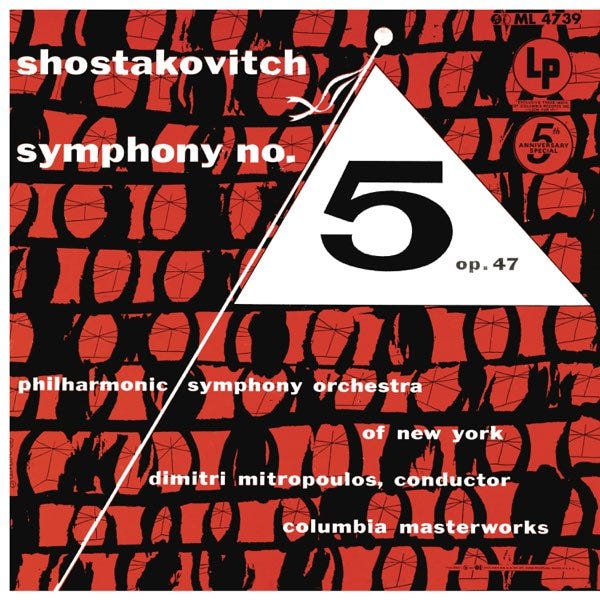
I have long been an admirer of the Greek American conductor Dimitri Mitropoulos, and I recommend his 1952 recording of the symphony with the New York Philharmonic on Sony. It is a fair assessment to say that I tend to favor the more intense and dramatic readings of this symphony, and this is certainly cut from that cloth. The rhythmic core is maintained while the emotional elements are particularly striking. The reading depicts power but also struggle, and in the end Mitropoulos doesn’t allow a triumphant ending, but rather a more ambiguous and defiant message is conveyed. The sound is serviceable for its age.
![Shostakovich - Leopold Stokowski Conducting The Stadium Symphony Orchestra Of New York – Symphony No. 5, Op. 47 – Vinyl (180g, LP, Album + 5 more), 1996 [r8214063] | Discogs](https://substackcdn.com/image/fetch/$s_!yDIz!,f_auto,q_auto:good,fl_progressive:steep/https%3A%2F%2Fsubstack-post-media.s3.amazonaws.com%2Fpublic%2Fimages%2F3765014d-6b31-4577-909f-ce4e8fa0cae8_594x600.jpeg "Shostakovich - Leopold Stokowski Conducting The Stadium Symphony Orchestra Of New York – Symphony No. 5, Op. 47 – Vinyl (180g, LP, Album + 5 more), 1996 [r8214063] | Discogs")
Leopold Stokowski shows up again in 1958, this time with the New York Stadium Symphony Orchestra (the New York Philharmonic under another name), a recording available on the Urania label. With Stokowski, you have to accept a good amount of portamento and some idiosyncratic gestures and phrases. But this is a passionate and intense reading with plenty of lyricism, color, and energy. While not quite as speedy as the pioneering 1939 recording, this is still among the quickest in total timing. If Stokowski doesn’t quite find the depth needed in the Largo, for me he more than compensates in the other three movements. Stokowski takes the final coda in a mostly triumphant vein. The sound is good, warm early stereo with some overload in climaxes.
![Shostakovich - New York Philharmonic, Leonard Bernstein, Philadelphia Orchestra, Eugene Ormandy, Yo-Yo Ma – Symphony No. 5 / Cello Concerto No. 1 – CD (Compilation, Reissue), 1989 [r2574056] | Discogs](https://substackcdn.com/image/fetch/$s_!kkzN!,f_auto,q_auto:good,fl_progressive:steep/https%3A%2F%2Fsubstack-post-media.s3.amazonaws.com%2Fpublic%2Fimages%2F082dda8c-4e38-48de-ae4e-a81d6fd7553f_600x596.jpeg "Shostakovich - New York Philharmonic, Leonard Bernstein, Philadelphia Orchestra, Eugene Ormandy, Yo-Yo Ma – Symphony No. 5 / Cello Concerto No. 1 – CD (Compilation, Reissue), 1989 [r2574056] | Discogs")
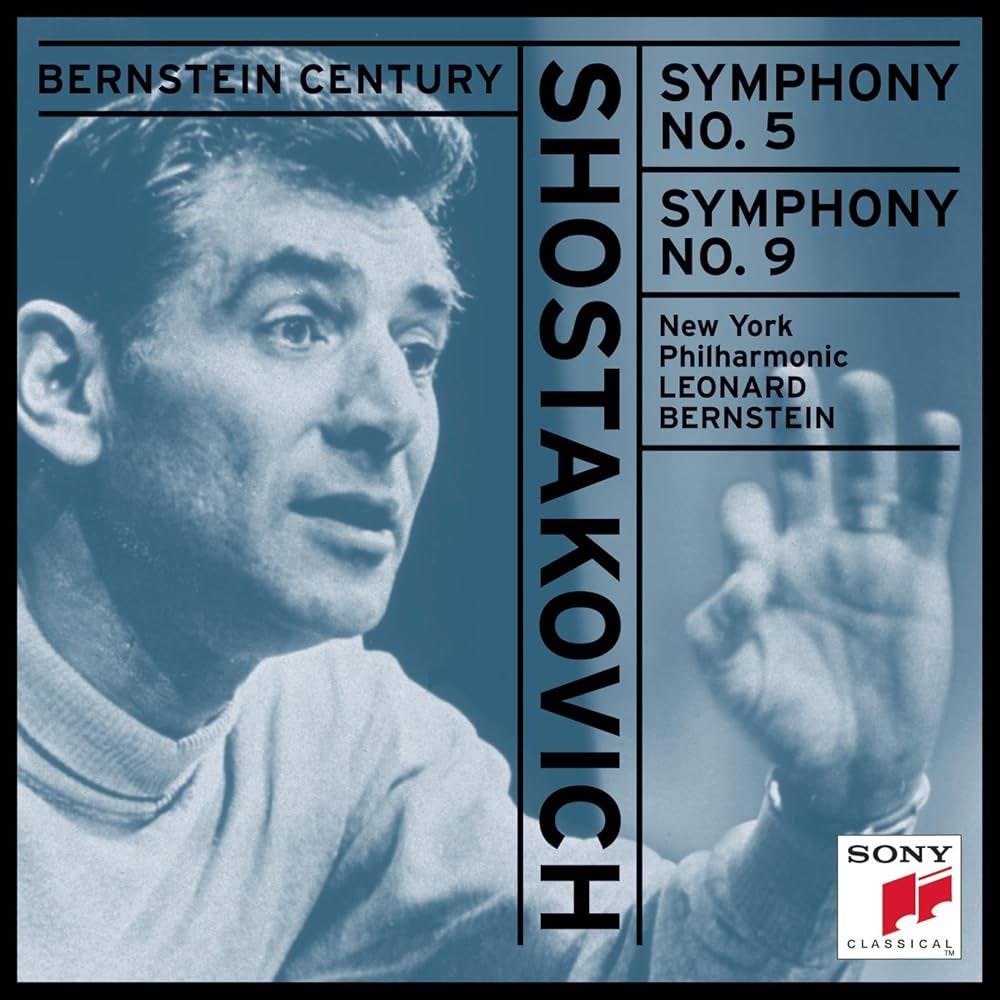
Not everyone will agree with me of course, but I believe I am on firm ground in saying that Leonard Bernstein’s recording of Symphony no. 5 with the New York Philharmonic from 1959 (on Columbia, now Sony) is one of the finest versions of this symphony. The recording was made at Boston’s Symphony Hall because it was thought the acoustic would be preferable. Not everyone will respond positively to Bernstein’s “hell for leather” approach, particularly of the finale. However, it must be said that Shostakovich himself approved of Bernstein’s treatment, and if you listen to Mravinsky’s recordings of the symphony (particularly his last one) you will find similar pacing. Meanwhile, his pacing in the central movements is actually slower than average. Bernstein’s rather manic style is off putting to some, but personally I find he brings more emotion, angst, thrill, and more searing drama to the symphony than most others. Listen to the buildup and tension before the big climax in the first movement, and then listen to how he wrings everything possible out of the Largo. I also recommend Bernstein’s later live recording with the New York Philharmonic in Tokyo from 1979 on CBS (Sony). It has many of the same qualities, although is marginally less impulsive and more spacious (although the finale blazes in a similar fashion). I would not want to be without any of Bernstein’s interpretations of Shostakovich’s symphonies. Some criticized Bernstein for treating Shostakovich too much like Mahler, but my belief is that Bernstein put his own stamp on it, and whether it appeals to you is down to your own taste.
Also from behind the iron curtain comes the very fine recording from Polish conductor Witold Rowicki and the Warsaw Philharmonic Orchestra, a recording made in 1958 by Deutsche Grammophon. At the time this was recorded, there were only a handful of stereo versions of the work. Rowicki’s pacing is ideal, not as frenetic as Bernstein in the outer movements, but phrasing still carries plenty of character and punch. The Allegretto has all the swagger you could want, and the Largo is deeply felt. The finale here is one of my favorites on record, and the Warsaw orchestra plays in what I would call more of a Russian style, which I enjoy. The closely miked recording, and the fine acoustics combine to help give this recording presence and the performance makes an impact. Climaxes are powerful, but Rowicki stays within established boundaries, while infusing plenty of drama. Recommended.
Similarly, the 1961 from the Czech Philharmonic under the vastly underrated Karel Ančerl on the Surpraphon label is recommended. Ančerl leads an emotionally raw and brooding reading, at least in the Moderato and Largo movements. The Allegretto is especially impressive, highlighting the superb CPO woodwinds and brass. This is once again a recording from behind the iron curtain, and that does make a difference in my view. There is simply something about it that feels right. It is a tightly controlled reading to be sure, but phrasing and dynamics are incisive and on point. The sound is not quite as full as the best stereo from the era, and there is a rawness and occasionally shrill aspect, but the sound is perfectly fine to appreciate the performance. While this may be a more straightforward reading without the extremes of Stokowski, Mravinsky, and Bernstein, the overall impression it leaves is quite satisfying.
![André Previn Conducts Shostakovich, London Symphony Orchestra – Symphony No. 5 – Vinyl (LP, Repress, Stereo), [r3470188] | Discogs](https://substackcdn.com/image/fetch/$s_!x-zh!,f_auto,q_auto:good,fl_progressive:steep/https%3A%2F%2Fsubstack-post-media.s3.amazonaws.com%2Fpublic%2Fimages%2F75f65300-5e31-4bbd-8a2d-41ffc98224b8_600x600.jpeg "André Previn Conducts Shostakovich, London Symphony Orchestra – Symphony No. 5 – Vinyl (LP, Repress, Stereo), [r3470188] | Discogs")
A surprise for me in the survey was André Previn’s 1966 recording with the London Symphony Orchestra (RCA/Sony). Honestly, I didn’t know Previn had this kind of fire in him. This is an intense, vibrant, and great sounding recording. Not surprisingly, Previn handles the more lyrical and balletic moments with aplomb. But the more dramatic and larger thematic sections are handled just as well. The Largo is one of the slowest on record, but for me Previn and the LSO play it as well as anyone. Previn balances everything well, and the level of detail heard rivals more modern recordings. Previn doesn’t try to play up the big finale, but rather takes a more measured approach. The brass instruments are big and bold, and the strings have an impressive sheen. An impressive recording.
![Shostakovitch, USSR Symphony Orchestra, Maxim Shostakovitch – Symphony No. 5 – Vinyl (LP, Stereo), 1971 [r2370091] | Discogs](https://substackcdn.com/image/fetch/$s_!9Np1!,f_auto,q_auto:good,fl_progressive:steep/https%3A%2F%2Fsubstack-post-media.s3.amazonaws.com%2Fpublic%2Fimages%2Fdfe922a7-786f-4779-9866-2fc1d30c2b53_300x294.jpeg "Shostakovitch, USSR Symphony Orchestra, Maxim Shostakovitch – Symphony No. 5 – Vinyl (LP, Stereo), 1971 [r2370091] | Discogs")
In 1971 the composer’s son Maxim Shostakovich took up the baton to record the Fifth with the State Orchestra of the USSR for the Melodiya label (later it showed up on RCA but I had trouble finding it on streaming services…it is on YouTube however). This recording bears the hallmarks of a real Russian sound, which I enjoy, but Shostakovich the younger is not nearly as manic as Mravinsky or Svetlanov. He employs reasonable tempos and dynamics, but he also creates excitement where necessary. In fact, his refusal to over-indulge is both an asset and a potential drawback. But overall, I find this an excellent performance. For me, M. Shostakovich’s later recording with the LSO is rather bland compared to this earlier one. The sound is a bit raw and unrefined, but the performance is none the worse for it.
The 1982 recording by Kurt Sanderling and the Berlin Sinfonie-Orchester on the Eterna label (formerly on Berlin Classics) also has the feel of authenticity. Sanderling met Shostakovich during World War II when Sanderling had fled Nazi Germany, and they became well acquainted. The Largo is played with the utmost devotion, and the East Berlin recording sounds much better than some others from the era and location. Sanderling is not in it to make a point, and so what you get is a satisfying and thoroughly idiomatic account which doesn’t resort to any tricks. Tempos and dynamics are in the mainstream, but Sanderling can also whip up a frenzy nicely, as he does at the climax in the Moderato. If you are looking for a solid rendition in good sound which also feels authentic, this may be the one for you.
The 1982 early digital recording on Decca by Bernard Haitink and the Royal Concertgebouw Orchestra has been a favorite of many listeners for years. While Haitink’s approach is mostly quite sober and straightforward, he has the advantages of an outstanding orchestra and rich and full sound. Indeed, this is the creamiest sounding Shostakovich Fifth you are likely to hear. But Haitink clearly loved Shostakovich, recording a complete cycle and then later re-recording several symphonies. Haitink is steady and clearheaded, builds the structure nicely, and allows the Concertgebouw to glow. Climaxes are effective, and the lovely Largo is very well done. If the extremes of Bernstein, Mravinsky, and Stokowski are not your bag, then I urge you to try this beautiful version.
![Imported classic CD EVGENY MRAVINSKY / SHOSTAKOVICH / SYMPHONIE N ° 5 op. 47 [Import Version] | Music software | Suruga-ya.com](https://substackcdn.com/image/fetch/$s_!qxH9!,f_auto,q_auto:good,fl_progressive:steep/https%3A%2F%2Fsubstack-post-media.s3.amazonaws.com%2Fpublic%2Fimages%2Fb43231a1-6146-4d21-b6a5-ec8a7673e52e_384x382.jpeg "Imported classic CD EVGENY MRAVINSKY / SHOSTAKOVICH / SYMPHONIE N ° 5 op. 47 [Import Version] | Music software | Suruga-ya.com")
Soviet and Russian conductor Yevgeny Mravinsky gave the premiere of the symphony, and he recorded it many times with his Leningrad Philharmonic Orchestra. However, some of the earlier recordings are not in decent sound. Fortunately, we have Mravinsky’s live 1983 recording on Erato (Warner) in good stereo sound. While he may have slowed down a bit (Mravinsky was 79 at the time), we can still fully hear his robust, Russian take on this symphony. There is almost a rawness to the orchestra, and certainly the brass, with Mravinsky definitely bringing out the more dramatic aspects of the score. Yet, Mravinsky avoids excessive gestures or exaggeration, and details are brought out wonderfully. The finale takes off like a rocket, leading to an exciting ride to the conclusion. For me, there is a sense that Mravinsky had particular insight into this music.
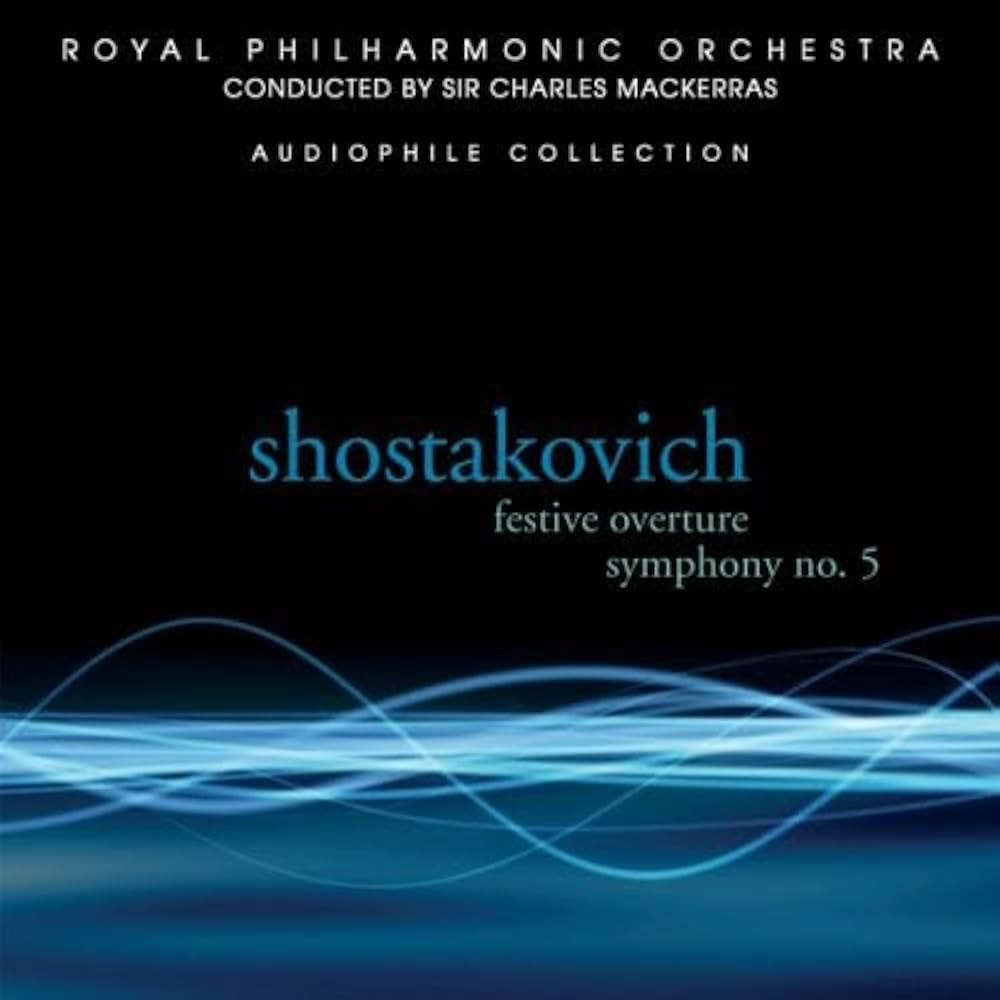
The Australian conductor Sir Charles Mackerras enters the recommendation list for Symphony no. 5 on the basis of his 1994 recording with the Royal Philharmonic Orchestra, which was produced by the RPO and has appeared on various budget labels. It was a bit of a surprise to me, and a very pleasant one at that, to discover that Mackerras had a compelling vision of this work. I should note the sound is excellent, if a bit overly bright. But the opening movement carries the drama forward very well, and the natural lilt in the second movement is delightfully executed. The finale makes a strong impact, and while Mackerras doesn’t quite convey the sheer terror of some other recordings, from a musical perspective this is really good.
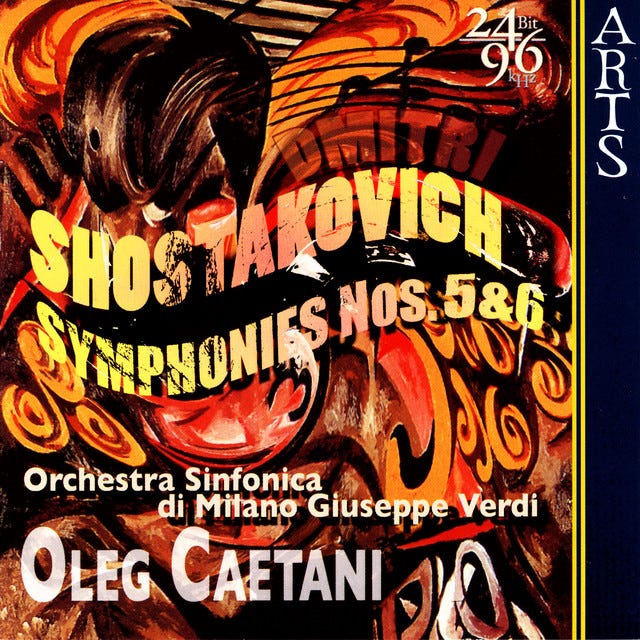
Another recommendation is the outstanding live recording by Oleg Caetani and the Orchestra Sinfonica di Milano Giuseppe Verdi from 2001 on the Arts label. The entire Shostakovich cycle from this source is well acclaimed, but the Fifth in particular is terrific. It is actually one of the more viscerally exciting versions I’ve heard of this symphony, and that is saying something. The entire performance has a sweep and forward momentum that is brilliant. If you think you need a Russian conductor or orchestra to produce a passionately unbuttoned reading, this recording smashes that assumption. I am particularly impressed by the weighty strings, and the raw sounding brass, ideal for this music in my view. Climaxes have the needed bite, and lyrical passages are properly balanced. The sound is close up and immediate, but quite clear and up to the highest standards. The bottom and the top in the sound picture are both satisfying and full. Highly recommended.
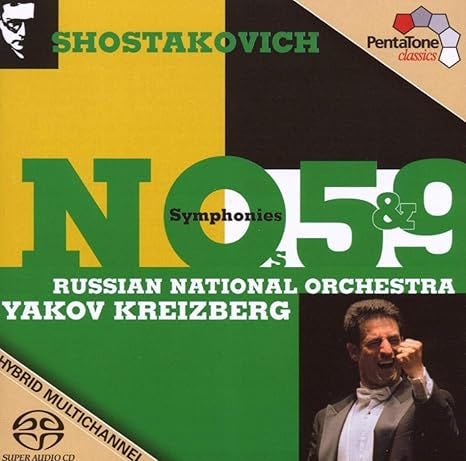
The 2006 recording by the late Yakov Kreizberg and the Russian National Orchestra on Pentatone is one of the best versions available. Kreizberg shows here why he is so missed by the classical music world. His attention to detail, the power he permeates the music with, and the way musicians under him responded so positively to his direction. What is immediately striking in this recording, besides the crystal-clear sound, is the depth and transparency Kreizberg and the RNO achieve. The symphony takes on some darker meaning in this recording, which I quite enjoy and find to be genuinely Russian in nature. The final movement is taken at a more measured, deliberate pace than some other recordings on this list, but it works because the intensity is maintained. Kreizberg definitely approaches the conclusion as satirically celebratory rather than truly triumphant.
![Shostakovich : Symphony no. 5 : SFS MEDIA 8 21936 0026 9 8 [KS]: Classical Music Reviews - April 2010 MusicWeb-International](https://substackcdn.com/image/fetch/$s_!OgdM!,f_auto,q_auto:good,fl_progressive:steep/https%3A%2F%2Fsubstack-post-media.s3.amazonaws.com%2Fpublic%2Fimages%2F99e060f9-e3a4-4299-9690-0dbbeedeffa4_300x298.jpeg "Shostakovich : Symphony no. 5 : SFS MEDIA 8 21936 0026 9 8 [KS]: Classical Music Reviews - April 2010 MusicWeb-International")
The 2007 recording by Michael Tilson Thomas and the San Francisco Symphony Orchestra on their home label, part of their “Keeping Score” series, was another complete surprise in my survey. Tilson Thomas seems to have taken his cue from his one-time mentor Bernstein in how he approaches the score. The performance was actually recorded live at the BBC Proms, and it is a tightly controlled, forwardly driven, dramatic, and bold performance. This is more reminiscent of earlier Bernstein rather than the later, sometimes bloated Bernstein. The highlight of the recording for me is the third movement Largo, here given a magnificent reading by MTT and the SFSO. Because they pull our emotional strings so well in the Largo, the final movement’s pomp simply cannot be taken at face value and that’s the point. If you have access to Tilson Thomas’ commentary on about the symphony on the album, that is also well worth hearing.
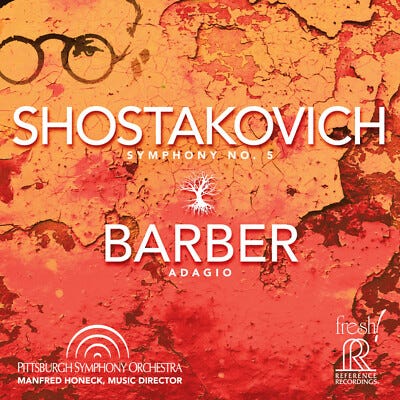
The excellent 2013 recording by the Pittsburgh Symphony Orchestra under their long-time director Manfred Honeck on the Reference label is consistent with their other outstanding releases in recent years. First, the sound is in the demonstration class, and we can hear and feel the weight and fullness of the sound. But Honeck emphasizes the thematic episodes perhaps in more stark contrast than some others, and in that it sometimes feels more like Mahler. What Honeck is suggesting is that Shostakovich wrote a very personal symphony (much like Mahler often did), but was more adept at hiding some of his more personal themes. Perhaps it is a message of struggle, suffering, and ultimately redemption, and of course these themes are common in many of Shostakovich’s works, as with many other composers. Tempos here are wisely chosen, and in the mainstream, but Honeck tends to be skilled at bringing out the long-breathed phrases, and so the lyrical passages are especially impactful. The finale has a moderate pace, but you can sense as the conclusion approaches that the ending will be more sarcastic than celebratory. This is a revelatory performance I definitely recommend.
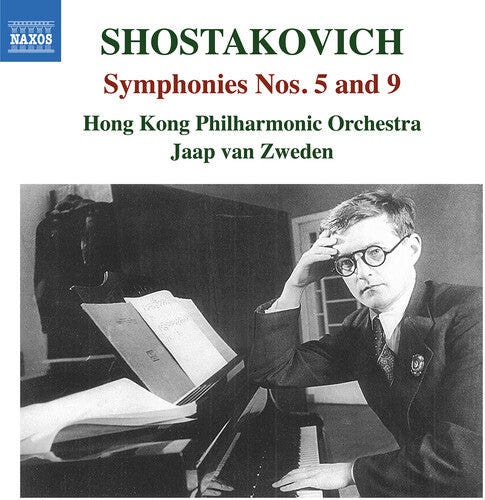
Finally in the top tier is the 2022 recording by Jaap van Zweden and the Hong Kong Philharmonic Orchestra on the Naxos label. While the Hong Kong orchestra may not be the first you might associate with Shostakovich, they play marvelously and fully acquit themselves in this music. Van Zweden leads a confident, and even strident, performance throughout with plenty of virtuosity and swagger. Climaxes are powerful and have the intended impact, I especially enjoyed the Allegretto’s bounce and verve. The Largo doesn’t linger by any means but still gives us what is needed in the emotional core. The finale begins conventionally, but then they hit the accelerator in a most thrilling way, the brass and strings being most impressive in this run. The central section slows down, and it is played most movingly. The care and thought put into the last half of the finale pays off splendidly with a powerful and fully convincing conclusion. The sound is spacious and resonant from the Hong Kong Cultural Centre.
Honorable Mention Recordings
As is often the case, many of the honorable mention recordings below are excellent, and the difference between the recordings above and these listed below is marginal. Depending on your listening tastes, you may prefer some of the recordings below.
Leningrad Philharmonic / Mravinsky (Melodiya 1954)
New York Philharmonic / Bernstein (Orfeo 1959)
Vienna Symphony / Horenstein (Vox 1961)
Suisse Romande / Kertesz (Decca 1962)
The Philadelphia Orchestra / Ormandy (Sony 1963)
Leningrad Philharmonic / Mravinsky (Praga 1965)
The Philadelphia Orchestra / Ormandy (RCA 1975)
USSR State Symphony / Svetlanov (Melodiya 1977)
National Symphony Orchestra / Rostropovich (DG 1983)
USSR Ministry of Culture / Rozhdestvensky (Melodiya/Olympia 1984)
Saint Louis Symphony Orchestra / Slatkin (RCA 1986)
Oslo Philharmonic / Jansons (Warner 1987)
Berlin Philharmonic / Bychkov (Philips 1987)
Royal Scottish National Symphony / Järvi (Chandos 1988)
Atlanta Symphony Orchestra / Levi (Telarc 1990)
St. Petersburg Philharmonic / Temirkanov (RCA 1996)
BBC Symphony / Wigglesworth (BIS 1996)
Vienna Philharmonic / Jansons (Warner 1997)
Mariinsky Orchestra / Gergiev (Decca 2003)
London Symphony Orchestra / Rostropovich (LSO Live 2005)
Gürzenich Orchestra Cologne / Kitajenko (Capriccio 2005)
Royal Liverpool Philharmonic Orchestra / Petrenko (Naxos 2008)
Boston Symphony Orchestra / Nelsons (DG 2015)
London Symphony Orchestra / Noseda (LSO Live 2016)
Rotterdam Philharmonic / Shani (Warner 2018)
Thank you once again for joining me, and I hope you will stick with me as we progress through our survey. 2026 will be an exciting year of discovery!
Happy New Year and best wishes for the week ahead!
______________
Notes:
“1980 Summer Olympics Official Report from the Organizing Committee, vol. 2”. p. 283. Archived from the original on 22 June 2006.
Blokker, Roy (1979). The Music of Dmitri Shostakovich, the Symphonies. The great composers. Associated Univ Press. ISBN 978-0-8386-1948-3.
Brown, Kellie D. (2020). The Sound of Hope: Music as Solace, Resistance and Salvation During the Holocaust and World War II. McFarland. ISBN 978-1-4766-7056-0.
Digonskaya, Ol’ga (2009). “About this Recording: 8.572138 – Shostakovich, D.: Girl Friends / Rule, Britannia / Salute to Spain (Polish Radio Symphony, Fitz-Gerald)”. Naxos Records. Archived from the original on 27 April 2022. Retrieved 26 April 2022.
Edwards, Robert (2006). White Death: Russia’s War on Finland 1939–40. London: Weidenfeld & Nicolson. ISBN 978-0-297-84630-7.
Fairclough, Pauline; Fanning, David, eds. (November 2008). The Cambridge Companion to Shostakovich. Cambridge Companions to Music (1st ed.). Cambridge University Press. ISBN 978-0-521-60315-7.
Fairclough, Pauline (2019). Dmitry Shostakovich. London: Reaktion Books. ISBN 978-1-78914-127-6.
Fay, Laurel (2000). Shostakovich: A Life. Oxford University Press. ISBN 978-0-19-513438-4.
Ho, Allan; Feofanov, Dmitry (1998). Shostakovich Reconsidered. Toccata Press. ISBN 978-0-907689-56-0.
Hulme, Derek C. (2010) [2002]. Dmitri Shostakovich Catalogue: The First Hundred Years and Beyond (4th ed.). Lanham, Maryland: Scarecrow Press. ISBN 978-0-8108-7264-6.
Khentova, Sofia (1975). Молодые годы Шостаковича, Книга 1 [The Young Years of Shostakovich, Book 1] (in Russian). Leningrad/Moscow: Советский композитор [Soviet Composer]. pp. 111–112.
Letter dated 19 July 1960, reprinted in Shostakovich & Glikman (2001), pp. 90–91.
Meyer, Krzysztof (1995). Schostakowitsch – Sein Leben, sein Werk, seine Zeit (in German). Bergisch Gladbach: Gustav Lübbe Verlag. ISBN 978-3-7857-0772-2.
Moshevich, Sofia (2004). Dmitri Shostakovich, Pianist. Montreal/Kingston: McGill-Queen’s University Press. ISBN 0-7735-2581-5.
Moynahan, Brian (2013). Leningrad: Siege and Symphony. New York: Atlantic Monthly Press.
Nabokov, Nicolas (1951). Old Friends and New Music. Hamish Hamilton.
North, James H. (2006). New York Philharmonic: The Authorized Recordings, 1917–2005. Scarecrow Press. p. 117. ISBN 978-0-8108-6239-5.
Service, Tom (23 September 2013). “Symphony guide: Shostakovich’s 15th”. The Guardian. Retrieved 8 May 2020.
Sheldon, Richard (25 August 1985). “Neither Yevtushenko Nor Shostakovich Should Be Blamed”. The New York Times. New York City. Retrieved 27 November 2019.
Shostakovich, Dmitri (1981). Shostakovich: About Himself and His Times. Compiled by L. Grigoryev and Y. Platek. Translated by Angus and Neilian Roxburgh. Moscow: Progress Publishers.
Shostakovich, Dmitri (1981). Dmitry Shostakovich: About Himself and His Times. Moscow: Progress Publishers. pp. 89–90.
“Shostakovitshin kiistelty teos kantaesitettiin” [Controversial work by Shostakovich premiered]. MTV3.fi (in Finnish). 1 September 2001. Archived from the original on 11 October 2009. Retrieved 20 August 2024.
“Shostakovich and his mysterious neurologic disease – Hektoen International”. Hektoen Internsational: A Journal of Medical Humanities. Hektoen Institute of Medicine. 23 August 2019. Retrieved 5 May 2023.
Sollertinsky, Dmitri; Sollertinsky, Ludmilla (1980). Pages from the Life of Dmitri Shostakovich. Translated by Graham Hobbs and Charles Midgley. New York and London: Harcourt Brace Jovanovich. ISBN 0-15-170730-8.
Testimony: The Memoirs of Dmitri Shostakovich (7th ed.). Proscenium. 2000. ISBN 978-0-87910-021-6.
Vishnevskaya, Galina (1985). Galina, A Russian Story. Translated by Guy Daniels (1st ed.). Harcourt Brace Jovanovich. ISBN 978-0-15-634320-6.
Volkov, Solomon (2004). Shostakovich and Stalin: The Extraordinary Relationship Between the Great Composer and the Brutal Dictator. Knopf. ISBN 978-0-375-41082-6.
Wilson, Elizabeth. Shostakovich: A Life Remembered (2nd ed.). Faber and Faber. 2006. ISBN 978-0-571-22050-2.
Woods, Kenneth. Explore the Score: Shostakovich- Symphony no. 5 in D minor. March 15. 2012. Found online at https://kennethwoods.net/blog1/2012/03/15/explore-the-score-shostakovich-symphony-no-5-in-d-minor/.
https://en.wikipedia.org/wiki/Symphony_No._5_(Shostakovich)#
https://en.wikipedia.org/wiki/Dmitri_Shostakovich?scrlybrkr=40ad99ec
Shostakovich is a composer that I greatly admire for his ability to capture such emotional depth along with his messages that he hides. I appreciate the dedication that you put into this, the recognition of such a wonderful composer should be brought to light. A man who composed under Stalin's fist and even through his Fifth Symphony, he managed to sneak in themes that were against Stalin yet Stalin still deeply enjoyed such. Truly, that is such a clever move that he was able to convey and demonstrate despite the consequences that could have occurred along with the Soviet government already being displeased with him. Thank you for recognizing such a brilliant and talented man with the piece that shapes history.
Thanks for such a great article. As a young trumpet player in Los Angeles I grew up listening to the Bernstein recording (over and over). Then in 1992 I did a tour of Japan with the Stockholm Royal Phil, conducted by Gennady Rostevensky, and I asked him if he thought the book Testimony was legit. His reply was the Shostakovich had told him personally many of the stories that were in the book.